Match Equipment to Homestead Work
Used equipment earns its place on a beginner homestead when it solves a recurring workload without consuming more money and storage space than the task justifies. Write down the jobs that currently require the most time or outside help: moving compost, mowing lanes, hauling firewood, preparing a planting area, clearing snow, digging post holes, or transporting feed. The equipment choice should follow those jobs, not a tempting listing that happens to be nearby.
A utility trailer may provide more value during the first year than a tractor because it can move lumber, fencing, mulch, livestock supplies, and harvested crops behind a suitable vehicle. A walk-behind mower can be a sensible purchase for maintained paths, while a compact tractor becomes more defensible when repeated hauling, grading, loader work, or attachment use justifies its cost. Specialized equipment such as a large wood chipper or commercial hay tool often sits unused on a small property and still requires maintenance.
Estimate frequency, material weight, terrain, and available storage before shopping. A machine that is adequate on level ground may be frustrating on wet clay or slopes. Likewise, an attachment is only useful if the tractor has the required hitch, hydraulic connections, lifting capacity, and power. Read the operator manual before buying when possible; the manual often reveals operating limits that a seller’s description omits.
One common mistake is treating horsepower or engine size as the main buying signal. A larger machine may have higher fuel use, more expensive tires, harder-to-find parts, and enough weight to damage soft ground. A smaller, common model in good condition can outperform a neglected larger one because it starts reliably and can be serviced locally. Make a short list of must-have capabilities and reject machines that do not meet them, even when the price looks unusually attractive.
Before browsing listings, compare this decision with the alternative of renting or hiring a service. Renting a tiller for one annual bed expansion may cost less than owning, storing, and repairing one. Buying a trailer or mower used may make sense because those tools serve many routine jobs. This kind of comparison keeps equipment from becoming an expensive substitute for a task that occurs only once.
Inspect Used Machines Before Paying
A useful inspection begins with the machine cold, clean enough to see its condition, and available for a real operating test. Ask the owner not to warm it up before arrival. A warm engine can hide hard starting, excessive smoke, weak compression, or a battery that is near failure. Look for oil, coolant, fuel, or hydraulic fluid around fittings, seals, hoses, the engine block, and transmission. A small stain is not proof of a major defect, but an active drip during operation deserves a repair estimate before negotiation.
Start the engine and listen for irregular knocking, sharp tapping, belt squeal, or unstable idle. Observe exhaust color and whether smoke changes as the engine warms and takes on load. Test every control rather than accepting a statement that an attachment “worked last season.” On a tractor, operate the loader, three-point hitch, power takeoff if equipped, steering, brakes, and transmission. On a tiller or mower, inspect engagement, vibration, blade or tine condition, and the gearbox area. For a trailer, examine the frame, coupler, safety chains, lights, wheel bearings, and tire date and condition.
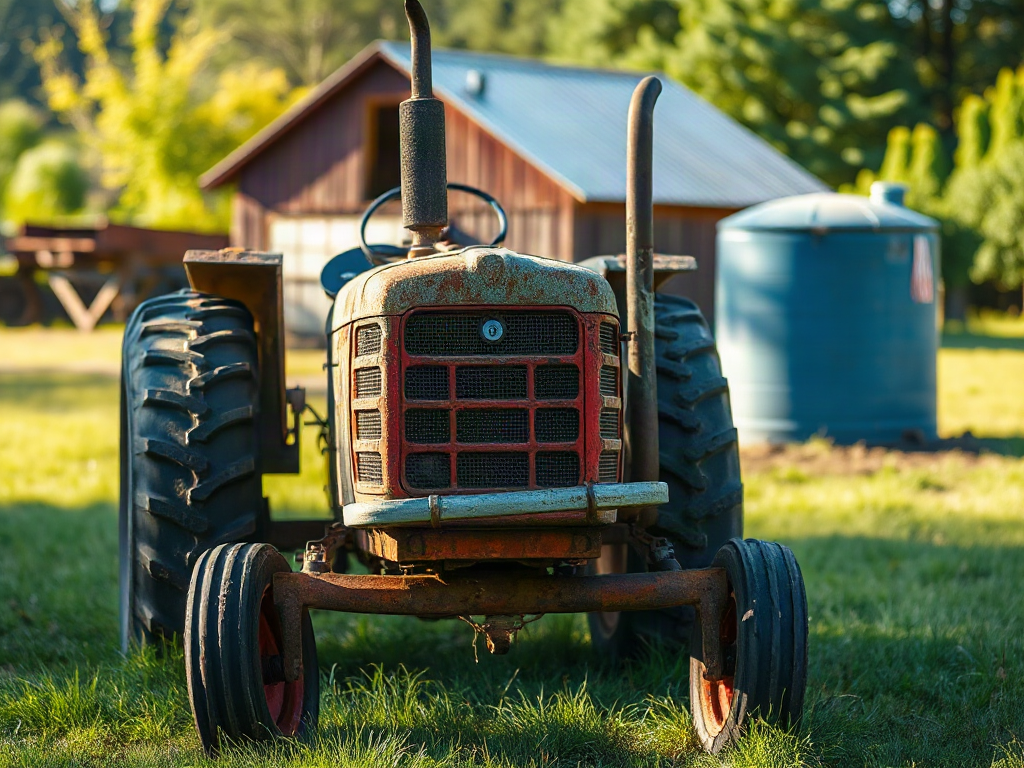
Rust requires interpretation. Surface rust on a handle or guard may be cosmetic, while rust perforation on a frame, fuel tank, deck, or axle can affect safety and repair cost. Bent metal often indicates impact or overloading. Welds are worth examining closely, especially around hitch points and loader arms. Cracked hydraulic hoses, frayed cables, missing shields, and improvised wiring are not minor details; they may signal neglected maintenance or unsafe operation.
Bring a flashlight, gloves, tire gauge, clean rag, phone camera, and a way to record model and serial numbers. Photograph worn parts and compare them with parts diagrams or dealer listings before making an offer. Ask what work was completed, where replacement parts were purchased, and why the equipment is being sold. Vague answers do not prove dishonesty, but they justify a lower risk-adjusted price.
Do not skip the load test. A mower that runs smoothly without cutting may bog down in tall grass, and a tractor that lifts an empty bucket may struggle with wet soil. If the seller refuses a reasonable test or inspection by a mechanic, treat that refusal as a cost rather than a challenge to overcome. A bargain is not a bargain if the first use reveals a failed clutch, overheating problem, or unsafe braking system.
Price Repairs, Parts, and Ownership
The purchase price is only the first number in a used-equipment budget. Add immediate service, transportation, safety repairs, and likely wear items before comparing listings. Fluids, filters, belts, spark plugs, batteries, tires, blades, tines, bearings, and hydraulic hoses can turn a seemingly inexpensive machine into a poor choice. The actual cost becomes clearer when each known defect receives a realistic parts-and-labor allowance.
Parts availability matters more to a beginner than peak specifications. A common mower or compact tractor with an active dealer network may be easier to keep running than an impressive discontinued model. Search the exact model number for an operator manual, parts diagram, belts, filters, and high-wear components. Ask a nearby repair shop whether it services that brand. A machine that needs a proprietary electronic module may be unsuitable for a remote homestead even if its engine and frame appear sound.
Use a simple price ceiling: purchase cost plus transport, immediate maintenance, known repairs, and a reserve for defects discovered after the first work session. A seller’s claimed repair value should not automatically be counted dollar for dollar. New tires may add value if they fit the machine and are properly installed, but a recent paint job does not offset worn bearings or a damaged gearbox. Receipts, service records, and a successful operating test deserve more weight than appearance.
Consider whether you can maintain the equipment yourself. Changing filters and greasing fittings may be realistic with basic tools, while hydraulic diagnosis, welding, tire mounting, or engine rebuilding may require professional help. Learning routine service can reduce ownership cost, but buying a machine that needs advanced work before it can perform its first job creates a poor starting point. A slightly newer, mechanically simpler tool may be a better fit than an older machine with sophisticated controls.
Transportation is another overlooked expense. Confirm the equipment’s weight, trailer capacity, loading method, tie-down points, and legal requirements before purchase. Never assume a borrowed trailer or improvised ramp is adequate. If delivery costs erase the price advantage, compare a local machine with a more distant “deal.” The safest purchase is often the one that can be inspected, loaded, and returned or repaired without a complicated logistics plan.
Buy in the Right Order
Prioritize used equipment according to immediate workload, versatility, and failure consequences. A beginner homestead usually benefits from tools that support several systems rather than equipment designed for one narrow crop or construction task. A sturdy hand truck, utility trailer, mower, fencing tools, and reliable hand tools may reduce daily friction before a tractor is needed. This does not make mechanized equipment unnecessary; it prevents a large purchase from arriving before the property is ready to use it.
A practical buying sequence starts with inventorying existing tools, measuring storage, and recording the next season’s projects. Group the projects by shared capability. If several jobs involve moving materials, compare a trailer, cart, compact loader, and hired delivery. If several involve fence installation, compare a post driver, auger attachment, and manual digging tools based on soil and fence length. The best used purchase is the one that eliminates repeated bottlenecks, not the one with the most attachments.
Use this compact screening process for each listing:
- Confirm the exact task, hours of use, terrain, and material the equipment must handle.
- Record the model, serial number, age, included attachments, and evidence of maintenance.
- Inspect cold-start performance, structural condition, controls, safety equipment, and leaks.
- Check manuals, parts sources, transport requirements, and local service options.
- Set a maximum all-in price and walk away when the seller will not permit testing.
Keep a written maintenance log after purchase. Record oil changes, grease points, belt replacements, tire pressure, battery dates, and unusual noises. Early notes help distinguish a normal service item from a developing failure. Store equipment under cover, clean soil and plant residue from moving parts, and address small leaks before dirt turns them into abrasive paste around seals and bearings.
Buying new can be the better alternative when safety-critical components are compromised, parts are unavailable, or the used price approaches a supported replacement. Buying used is strongest when the machine has a known history, common service parts, visible wear that can be priced, and a role in the homestead’s actual workload. Avoid building a fleet around imagined future projects. Let completed work demonstrate what capability you need next.
Before operating a used machine, consult the manufacturer’s operator manual and service documentation for the exact model. University extension programs, recognized farm-safety organizations, and local equipment dealers can provide additional guidance on safe loading, maintenance, personal protective equipment, and attachment limits. Documentation specific to the machine is more useful than relying on a seller’s informal instructions.
Frequently Asked Questions
What used equipment should a beginner buy first?
Choose equipment tied to frequent work and usable across several projects. A trailer, mower, cart, fencing tools, or compact tractor may be appropriate depending on the property, but renting specialized tools is often cheaper for occasional jobs.
How can I tell if a used tractor is worth buying?
Inspect it cold, test the engine and hydraulics under load, examine the frame and tires, verify attachment compatibility, and price parts and repairs. Service records and local parts availability add practical value.
Should I buy equipment with visible rust?
Surface rust may be manageable, but rust-through on structural members, decks, tanks, axles, or hitch points can create safety and repair problems. Inspect the affected area closely and obtain a repair estimate before proceeding.
Is a low-hour machine always the better choice?
No. Low hours do not reveal storage quality, maintenance, misuse, or age-related deterioration. A regularly serviced machine with documented use may be safer than a neglected machine with an attractive hour reading.
What should I budget after buying used equipment?
Reserve money for transport, fluids, filters, belts, blades or tines, battery service, tires, safety repairs, and defects found during the first workload. Calculate an all-in price before making an offer.
Conclusion
Used equipment can expand a beginner homestead without requiring a new-machine budget, but only when the purchase is tied to real work and inspected as a mechanical system. Define the recurring bottleneck, compare ownership with renting, and favor common models with manuals, parts, and local service support. Test machines cold and under load, inspect structural and safety components, and include transport and immediate maintenance in the offer. A clean appearance, low hour count, or unusually low price cannot compensate for a damaged gearbox or unavailable parts. Buy one versatile tool at a time, maintain it from the first day, and let completed projects reveal which capability deserves the next investment.