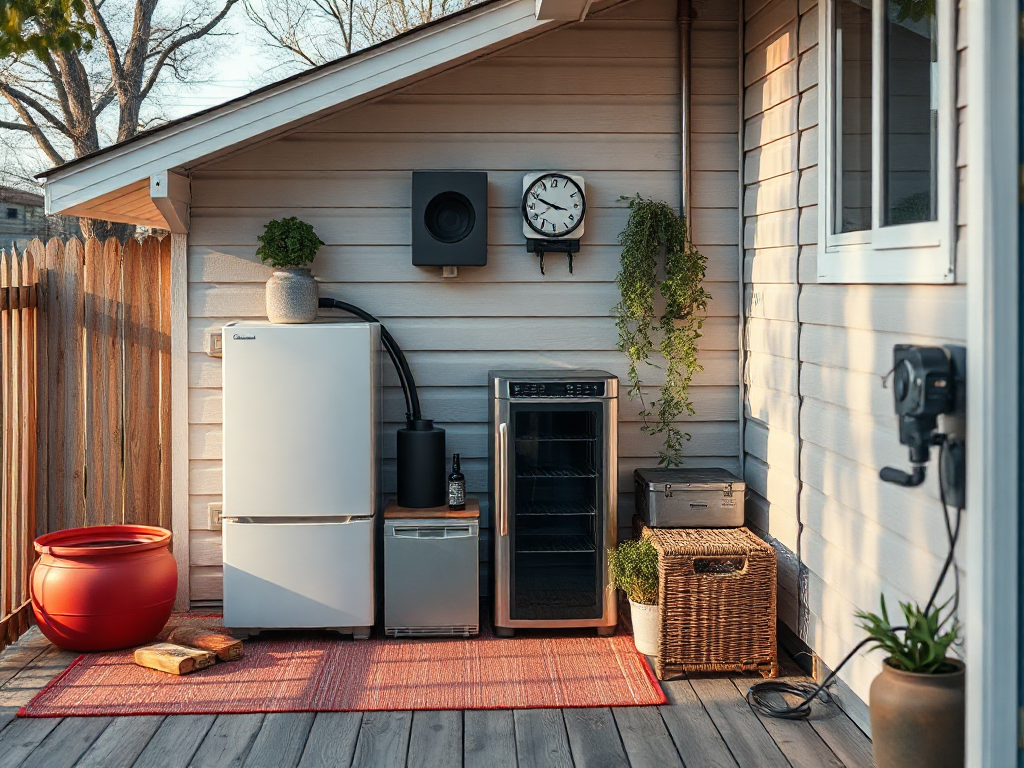
DC appliances lowering autonomous household energy consumption works by reducing the conversion losses created when battery power is repeatedly changed from direct current to alternating current and back again. Efficient DC refrigerators, lighting, ventilation fans, pumps, electronics, and communications equipment can connect more directly to a battery system, reducing inverter runtime and simplifying power management. The gains are greatest when appliances operate for many hours or use motors and standby electronics. Voltage matching, wire sizing, fuse protection, controller compatibility, and dependable service support matter as much as nameplate efficiency. Replacing every household appliance is rarely the best first move; measure actual loads, target continuous users, and preserve AC equipment where its conversion penalty is modest.
Where Direct-Current Appliances Save Energy
Autonomous homes commonly store electricity in batteries, and batteries naturally supply direct current. A conventional household appliance designed for alternating current therefore needs an inverter before it can operate. That conversion is not free: the inverter consumes some energy while changing voltage and waveform, and it may draw a small standby load even when the appliance is idle. A DC appliance can avoid part of that path by using the battery system’s current more directly.
The largest advantage appears in loads that run frequently. A DC refrigerator, for instance, may use a dedicated compressor controller designed for battery operation, while an AC refrigerator requires an inverter and may create a short but demanding startup surge. DC LED lighting similarly avoids running an inverter throughout the evening merely to power low-voltage lamps. Fans, circulation pumps, routers, monitors, and charging equipment can offer comparable opportunities when their operating schedules are predictable.
Direct connection does not automatically mean low consumption. A poorly designed DC motor, undersized pump, inefficient refrigerator, or long cable run can erase the expected benefit. The meaningful comparison is the energy used at the battery terminals over a complete operating cycle, not the label on the appliance alone. Include conversion losses, startup behavior, idle draw, wiring loss, and seasonal runtime.
A useful first measurement is a household load inventory. Record each appliance’s voltage, running watts, estimated hours per day, startup characteristics, and whether it operates during the battery’s most constrained period. A small AC device used for ten minutes may not justify replacement, while a ventilation fan running continuously can deserve close attention. Readers assessing their own setup can also compare the findings with DC appliances lowering autonomous household energy consumption as a system-design question rather than a shopping trend.
The Household Loads Worth Converting First
The strongest candidates are usually continuous or daily loads with a simple DC equivalent. Lighting, refrigeration, ventilation, communications, and small water pumps often fit that description. Their energy use accumulates over many hours, so avoiding repeated inverter operation may matter more than the appliance’s peak wattage. A DC refrigerator with a variable-speed compressor can also reduce battery stress by avoiding the sharp startup demand associated with some AC motors.
Lighting is an easy example, but it should be evaluated at the fixture rather than the bulb package. A 12-volt or 24-volt LED system can be efficient when lamps, switches, dimmers, and wiring are designed as one system. Converting an AC lighting circuit to an improvised low-voltage arrangement may introduce poor connections, voltage drop, or incompatible controls. A purpose-built DC lighting circuit is usually easier to protect and troubleshoot than a collection of adapters.
Water systems require more judgment. A small pressure pump may be a good DC candidate in a modest residence, especially if it runs from a nearby battery or dedicated controller. A high-flow pump serving irrigation, a deep well, or a pressure tank may require substantial current and heavy conductors. In that situation, an efficient AC pump operating briefly through a properly sized inverter can be more practical than distributing very high DC current over a long distance.
Electronics are another common source of hidden conversion loss. Networking equipment, televisions, laptop chargers, radios, and monitoring devices often convert AC back to DC internally. A direct DC power supply can remove one conversion stage, but proprietary voltage requirements and connector polarity make casual substitutions risky. Use the manufacturer’s specified input range and protection requirements. The mistake to avoid is treating every barrel connector or USB outlet as interchangeable.
- Prioritize first: equipment that runs many hours, has a known DC version, and sits close to the battery or distribution point.
- Evaluate carefully: pumps, compressors, heating equipment, and appliances with high startup or surge demand.
- Usually leave for later: occasional kitchen tools and low-use devices whose inverter energy is small compared with replacement cost.
AC appliances still have a place in an autonomous household. They are often cheaper, easier to replace locally, and available in a wider range of capacities. A mixed system may therefore outperform an all-DC conversion project when reliability, service access, and purchase price are included. The aim is lower battery-side energy use, not loyalty to one current type.
Voltage, Wiring, and Protection Decisions
Voltage selection determines whether a DC appliance project remains manageable. For the same power, a lower-voltage circuit carries more current. A 120-watt appliance draws about 10 amps at 12 volts before accounting for losses, but about 5 amps at 24 volts. Higher current requires larger conductors, shorter runs, stronger connectors, and appropriately rated fuses. That is why a 24-volt or 48-volt distribution system may suit a larger autonomous home better than a long network of 12-volt branches.
Voltage drop is more than a performance nuisance. It can make motors start poorly, cause controllers to shut down, dim lights, or generate heat at connections. Calculate the complete circuit length, including the outbound and return conductors, and use the appliance’s operating and startup current. A device that works perfectly beside the battery may fail in a remote outbuilding because the cable run is too long.
Protection must be designed around the source and the conductor. Every branch needs overcurrent protection matched to the wire and appliance, with disconnects that can be reached during service. Batteries can supply very high fault current, so an unfused DC cable can become a serious hazard even when the appliance itself is small. Use components rated for the system’s DC voltage and fault conditions; an AC breaker is not automatically suitable for interrupting a DC arc.
Consider a 24-volt pump installed forty feet from a battery enclosure. The pump may have an acceptable running load, yet a marginal cable can create enough voltage drop during startup to trigger repeated controller faults. Increasing conductor size, shortening the run, or moving the DC-to-DC conversion closer to the pump may solve the problem. Choosing a larger appliance without checking the circuit usually makes the failure harder to diagnose.
Compatibility also extends to charging and control equipment. Some appliances require regulated voltage, while others tolerate a defined range. Battery voltage changes with state of charge, temperature, chemistry, and charging activity. A direct battery connection is appropriate only when the appliance is designed for that variation. Otherwise, use a properly rated regulator or DC-to-DC converter. Do not assume that a nominal “12-volt” label describes every voltage the appliance will experience.
Planning a Reliable DC Appliance System
A reliable design begins with measurements rather than a catalog. Use a DC meter, shunt-based monitor, or suitable plug-in energy monitor on the existing system to identify daily watt-hours and peak demand. Measure appliances during real operation: refrigeration cycles, pump starts, evening lighting, and communications equipment may produce a very different profile from the numbers printed on a specification sheet.
Next, separate energy savings from infrastructure cost. Replacing a heavily used AC refrigerator may reduce inverter loading and simplify battery planning, but a lightly used blender does not justify a new circuit. Include appliance price, spare-parts availability, cable, fuses, switches, connectors, conversion equipment, and installation time. A useful project can be phased: begin with lighting and communications, then address refrigeration or pumping after the monitoring data confirms the opportunity.
Keep the system understandable for the people who will maintain it. Label every circuit with voltage, polarity, fuse rating, and destination. Use consistent connectors and keep appliance-specific adapters accessible. A technically efficient installation that depends on an obscure controller or an unavailable replacement part can reduce household resilience when something fails.
Testing should happen before the system is closed up. Check polarity, measure voltage at the appliance while it starts, inspect warm connections after sustained operation, and confirm that protective devices interrupt the intended circuit. Signs of a healthy installation include stable appliance operation, no unexplained controller resets, cool terminals, and battery consumption that matches the measured load estimate. Flickering lights, hot plugs, nuisance shutdowns, or a battery monitor showing unexpectedly high overnight use point toward wiring, standby, or compatibility problems.
A practical sequence is:
- Measure the present AC and inverter-side energy use.
- Rank loads by daily runtime, startup demand, and replacement availability.
- Select a voltage and distribution route that keep current and cable losses reasonable.
- Specify fuses, disconnects, regulators, and conductors before buying appliances.
- Install one priority circuit, test it under normal conditions, and compare actual battery-side consumption.
The most common weak assumption is that eliminating the inverter eliminates all losses. Controllers, regulators, cable resistance, battery charge and discharge losses, and appliance standby consumption remain. Another mistake is optimizing watt-hours while ignoring household function. A refrigerator that saves energy but cannot maintain safe temperatures, or a pump that cannot meet peak water demand, is not a successful upgrade. Use DC appliances lowering autonomous household energy consumption as a design filter: lower consumption must remain compatible with serviceability and daily needs.
Balancing Efficiency With Cost and Serviceability
Direct-current equipment is most valuable when it matches the home’s operating pattern and the battery architecture already in place. A small cabin with short cable runs may benefit from a compact 12-volt system. A larger residence with several outbuildings may need a higher-voltage backbone and local conversion near each load. The same appliance can be sensible in one installation and awkward in another because distance, current, and access change the calculation.
Purchase decisions should include the failure scenario. Ask whether replacement parts can be obtained, whether the appliance has a documented voltage range, and whether a temporary AC alternative can keep the home functioning. A specialized DC freezer may be efficient but difficult to replace quickly. A common AC model may consume more battery energy yet remain easier to service. Keeping one compatible spare controller, fuse set, or power supply may be more useful than buying a marginally more efficient appliance.
Heating and cooking deserve particular caution. Resistive loads draw large amounts of energy regardless of whether they are supplied by AC or DC, and converting them to direct battery power does not change the basic heating demand. An electric kettle used briefly may be less significant than a refrigerator running all day, while electric space heating can dominate the entire energy budget. Prioritize operating hours and thermal demand instead of assuming that DC labeling means low consumption.
For a household with limited generation, the best result often comes from combining efficient appliances with scheduling. Run pumps and other discretionary loads when generation is available, reduce idle electronics overnight, and reserve battery capacity for refrigeration, communications, and essential water systems. DC equipment can make those choices easier by reducing inverter overhead, but it does not replace capacity planning.
A sensible final check asks whether the proposed change reduces measured battery-side watt-hours, lowers peak inverter demand, improves fault tolerance, or simplifies operation. If it does none of those things, the conversion may be an expensive wiring exercise. If it does one or more, document the baseline and verify the result after installation. That evidence is more reliable than a nominal efficiency claim and can guide the next upgrade, including the broader system choices discussed in DC appliances lowering autonomous household energy consumption.
Frequently Asked Questions
Do DC appliances always use less energy than AC appliances?
No. DC appliances may avoid inverter losses, but appliance efficiency, controls, wiring length, standby draw, and operating conditions determine the actual result.
Which DC appliance should an autonomous household replace first?
Start with a frequently used load such as lighting, refrigeration, ventilation, or communications equipment after measuring its real battery-side consumption.
Is 12-volt DC suitable for an entire home?
It can suit small systems with short cable runs, but higher-power homes often need 24- or 48-volt distribution to reduce current, cable size, and voltage drop.
Can an AC circuit breaker protect a DC appliance circuit?
Not automatically. DC circuits require protection devices rated for the system voltage and the fault-interruption conditions; use components specified for DC service.
How can I confirm that a DC conversion saved energy?
Record comparable operating periods with a meter or battery monitor, including runtime, battery state, inverter losses, and weather or occupancy differences that affect demand.
Further Reading
Authoritative Sources
- Academy of Nutrition and Dietetics
eatright.orgProfessional nutrition guidance, healthy eating resources, and practical dietitian-reviewed advice.
- U.S. Department of Agriculture
usda.govOfficial food, nutrition, agriculture, and consumer guidance from the USDA.
- NIH Office of Dietary Supplements
ods.od.nih.govResearch-based fact sheets on nutrients, supplements, dietary intake, and safety considerations.
- International Society of Sports Nutrition
sportsnutritionsociety.orgEvidence-informed sports nutrition resources and position stands for active people and athletes.
Conclusion
DC appliances can lower autonomous household energy consumption when they replace frequent loads that would otherwise pass through an inverter. The strongest candidates are usually refrigeration, lighting, ventilation, communications, and appropriately sized pumps, not every appliance in the building. Measure actual usage first, compare battery-side energy rather than nameplate watts, and design voltage, cable size, fuses, regulators, and disconnects as one system. Keep serviceability in the decision: a modest efficiency gain may not justify scarce parts or difficult troubleshooting. Begin with one high-runtime circuit, verify its performance under normal conditions, and use the measured result to guide later upgrades. Efficient equipment matters, but sound wiring and realistic load priorities determine whether the savings survive daily operation.