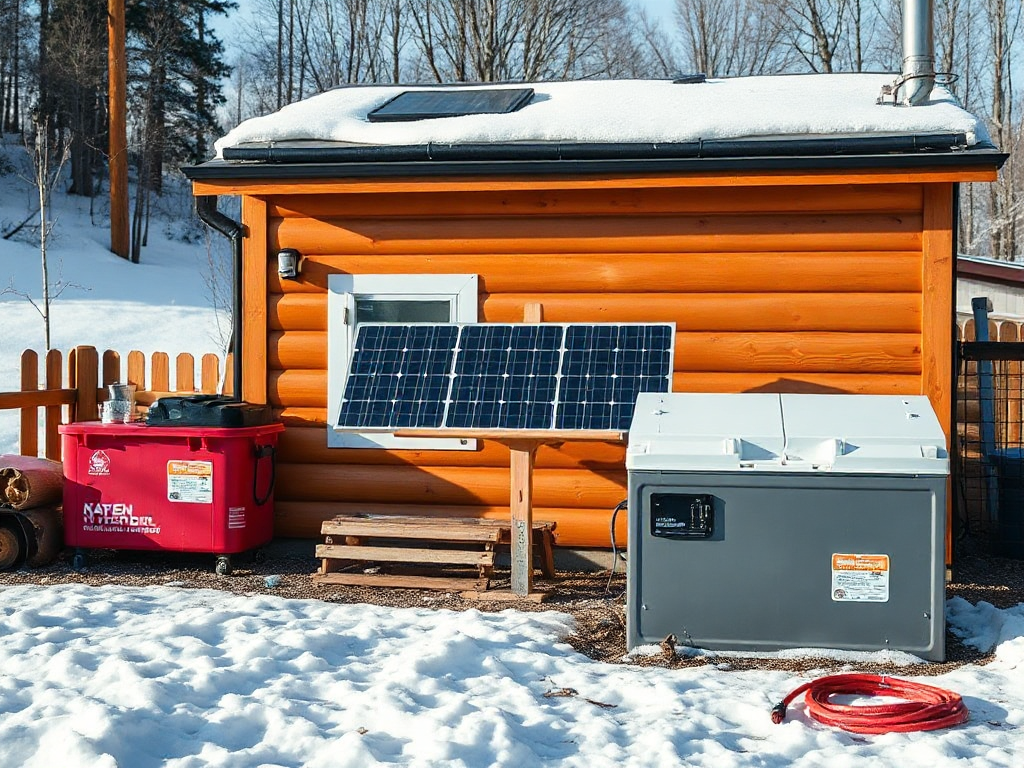
Off-grid solar battery sizing for winter autonomy depends on your daily energy use, the number of low-sun days you want to cover, usable battery capacity, and the reduced performance of batteries in cold conditions. Calculate winter loads in watt-hours, multiply them by planned autonomy days, and divide by the battery’s permitted depth of discharge and system efficiency. Size solar production separately so the array can replace that energy during short, cloudy winter days. A battery that looks adequate on paper may fail when heating loads rise, snow covers panels, or lithium batteries are too cold to charge. Build a load schedule, use conservative winter solar estimates, and retain a generator or other contingency for extended storms.
Define Winter Loads and Autonomy Days
Winter battery sizing begins with an honest energy inventory, not the nominal wattage printed on a battery label. Record every electrical load that must operate during the least productive season, including refrigeration, lighting, communications, water pumping, controls, ventilation, tools, and inverter standby consumption. Seasonal habits matter: a freezer may run longer in a cold building, a well pump may run more often when livestock water freezes, and indoor lighting usually operates for more hours.
Convert each appliance into daily watt-hours. Multiply watts by estimated hours of operation, then add the results. For loads with duty cycles, use measured consumption where possible rather than assuming the nameplate rating runs continuously. A 100-watt refrigerator does not normally consume 2,400 watt-hours per day, while an inverter may draw power around the clock even when useful appliances are off.
Autonomy days describe how long the battery should carry essential loads without meaningful solar input. Two days may suit a system with dependable winter sun and a readily available generator; four or five days may be more appropriate where storms, snow, or difficult fuel access are common. More autonomy improves resilience but increases battery cost, physical size, and the amount of solar generation needed to recharge it.
Separate essential and discretionary loads before doing the final calculation. A communications modem, refrigerator, circulation pump, and medical equipment may belong on the essential panel, while workshop tools, laundry, and water heating can wait for sunny periods. This load hierarchy is often more useful than simply buying a larger battery. Readers comparing designs can also review Off-grid solar battery sizing for winter autonomy alongside their own appliance measurements.
Calculate Usable Battery Capacity
The battery bank must store more energy than the loads consume because not all nameplate capacity is available for routine use. A practical planning equation is: required nominal battery energy equals daily winter consumption multiplied by autonomy days, divided by permitted depth of discharge and overall system efficiency. If essential loads use 5 kilowatt-hours per day, the design calls for three autonomy days, the permitted depth of discharge is 80 percent, and the estimated battery-to-load efficiency is 90 percent, the nominal requirement is about 20.8 kilowatt-hours.
The calculation is only as sound as its inputs. Depth of discharge is not the same as a manufacturer’s theoretical maximum; the operating window may be narrower if long service life, reserve capacity, or warranty conditions matter. System efficiency should account for inverter losses, wiring, battery conversion losses, and any low-voltage shutdown margin. A battery-management system may disconnect loads before the advertised empty point, particularly during high current demand.
Battery chemistry changes the interpretation. Lithium iron phosphate batteries commonly offer a larger usable operating window and lower standby loss than lead-acid banks, but they require charge-temperature protection and appropriate charging equipment. Lead-acid batteries may need a shallower routine discharge to limit wear and can lose effective capacity under heavy loads or cold conditions. Comparing banks by nominal kilowatt-hours alone can make a cheaper, larger lead-acid installation appear equivalent to a smaller lithium system when the usable energy and maintenance requirements differ.
Peak power is a separate check from stored energy. A well pump, freezer compressor, or induction appliance may briefly demand several times its running wattage. Confirm that the inverter, battery discharge rating, cables, and protective equipment can support starting surges without a low-voltage trip. A system that has enough kilowatt-hours but cannot start its pump is undersized in practice.
Match Solar Production to Winter Recovery
A battery provides nighttime and storm coverage; the solar array determines whether that reserve can be restored. Winter planning should use the location’s conservative seasonal solar resource, panel orientation, shading, snow exposure, and the losses between modules and battery. Annual average production is a weak basis for winter autonomy because it hides the short days and prolonged cloud periods that create the actual design pressure.
Begin with the energy that must be replaced each day, then add the energy needed to recover from an autonomy event. If the battery has supplied two days of essential loads, the array must first serve the new day’s consumption and then send surplus energy into the bank. A small array may operate the house adequately in clear weather yet remain permanently behind after a three-day storm. Oversizing the array can be more economical than adding indefinite battery capacity, provided the charge controller, wiring, inverter, and battery acceptance rate are compatible.
Consider the difference between a daily energy deficit and a temporary storage deficit. More batteries help when evening loads exceed daytime production, but they do not create energy. If the array produces too little during a cloudy week, a larger bank simply takes longer to refill. Conversely, a large array with a very small battery may waste midday production or force load shifting that is impractical for pumps and refrigeration.
Snow and shade deserve physical attention. A steep roof or accessible ground mount may shed snow more readily, while a chimney or nearby evergreen can cast a disproportionately damaging winter shadow when the sun is low. Do not assume that panels will be cleared safely by hand; access, roof pitch, and electrical isolation affect the real operating plan. A useful recovery test is to inspect whether the battery reaches its normal upper charge target on clear winter days after ordinary overnight use. If it does not, measure array output and charge settings before purchasing more storage.
Account for Cold, Aging, and Backup Limits
Cold weather changes both battery behavior and the reliability of the surrounding system. Lithium batteries generally need charging inhibited below the manufacturer’s permitted temperature, even if they can discharge in colder conditions. A heated enclosure, internal heating system, or temperature-controlled utility space may be necessary, and that heating energy belongs in the winter load calculation. Lead-acid batteries also deliver less effective capacity in cold conditions, so an outdoor installation may need additional margin.
A battery’s capacity declines with age and use. Designing to the exact calculated minimum leaves little room for degradation, unexpected loads, or a battery-management system reserve. The appropriate margin depends on the cost of replacement, the consequences of losing power, and whether a generator is available. Critical refrigeration or water systems warrant a different risk tolerance from a seasonal cabin that can be shut down.
Backup equipment changes the sizing decision rather than making sizing irrelevant. A generator can cover an unusually long weather event, but it may be difficult to start automatically, unavailable during fuel shortages, or inefficient at very light loads. Plan which loads the generator will serve, how it connects to the inverter or distribution panel, and whether it can charge the battery at a useful rate. A manual backup plan should identify the trigger for starting it, such as a low state-of-charge threshold combined with a poor weather forecast.
Common mistakes include counting the full battery label as usable, ignoring inverter idle draw, placing a lithium battery where it cannot safely charge in freezing conditions, and assuming a generator will rescue an inverter that is already offline. The remedy is a written operating limit: minimum battery temperature, low-state-of-charge action, maximum discretionary loads, and the inspection required after snow or a prolonged outage.
Build and Validate the Final System Plan
A sound design is a linked set of checks: winter loads, usable storage, solar recovery, peak power, temperature, and backup operation must agree. Start with a spreadsheet containing each appliance, running watts, estimated hours, daily watt-hours, and whether it is essential. Add inverter standby consumption and seasonal loads that are easy to overlook, such as heat tape, network equipment, battery heating, and pump controls.
Use this compact sequence before ordering equipment:
- Measure or conservatively estimate essential winter watt-hours per day.
- Select autonomy days based on local weather, access, and backup availability.
- Convert the energy target into nominal capacity using usable depth of discharge and efficiency.
- Check continuous and surge power against the inverter and battery specifications.
- Verify that winter solar production can serve daily loads and restore the reserve.
- Confirm cold-weather charging limits, ventilation, protection, monitoring, and service access.
After installation, validate the model with actual observations. Compare overnight battery change with the predicted load, record midday solar output on clear and cloudy days, and note whether the battery reaches its intended charge level. A persistent gap may come from an unlisted load, shading, incorrect charge settings, or a battery that is being held below its expected operating window. Monitoring is more informative than relying on a single state-of-charge percentage, which can become less reliable when batteries are cold, aged, or recently subjected to high current.
Keep the design adjustable. Load shifting—running laundry, pumping water, or charging tools during strong solar periods—can reduce winter battery cycling. If that behavior is unrealistic, install enough storage and backup capacity to match actual habits rather than an idealized schedule. For additional planning context, connect these calculations with Off-grid solar battery sizing for winter autonomy and document the final assumptions for whoever will maintain the system.
Frequently Asked Questions
How many autonomy days should an off-grid battery cover in winter?
Choose the number from local storm patterns, essential loads, fuel access, and generator availability. Two days may suit a well-supported site, while remote or critical systems may justify more storage.
Should winter battery capacity be based on total household electricity use?
Base the primary bank on essential loads, then decide whether discretionary loads deserve additional capacity. Separating the circuits usually costs less than sizing every component for worst-case household use.
Does a larger solar array reduce the battery size needed?
It can reduce the storage needed for overnight use and improve recovery after cloudy weather, but it cannot replace storage when loads occur after dark or during extended periods with little solar input.
Can lithium batteries be charged in freezing weather?
Only if the specific battery and its controls permit charging at that temperature. Many lithium systems require charge inhibition or battery heating below a specified threshold, so follow the manufacturer’s limits.
What is the most common winter sizing mistake?
Counting nominal battery capacity as fully usable while using annual solar averages is a frequent error. Apply depth-of-discharge and efficiency limits, then test the array against conservative winter production.
Further Reading
Authoritative Sources
- Academy of Nutrition and Dietetics
eatright.orgProfessional nutrition guidance, healthy eating resources, and practical dietitian-reviewed advice.
- U.S. Department of Agriculture
usda.govOfficial food, nutrition, agriculture, and consumer guidance from the USDA.
- NIH Office of Dietary Supplements
ods.od.nih.govResearch-based fact sheets on nutrients, supplements, dietary intake, and safety considerations.
- International Society of Sports Nutrition
sportsnutritionsociety.orgEvidence-informed sports nutrition resources and position stands for active people and athletes.
Conclusion
Reliable winter autonomy comes from matching several modest calculations rather than choosing a battery by its headline capacity. Measure essential loads, include inverter and temperature-related consumption, select realistic autonomy days, and convert the energy target into usable—not nominal—storage. Then verify that the solar array can cover daily demand and rebuild the reserve after cloudy weather. Cold-charge limits, aging, snow, surge loads, and backup procedures deserve written design assumptions because each can turn an apparently adequate system into an unreliable one. After commissioning, compare monitored production and consumption with the spreadsheet and revise operating rules before expanding hardware. A conservative, measured plan usually delivers more dependable winter service than an oversized battery paired with inadequate solar recovery.