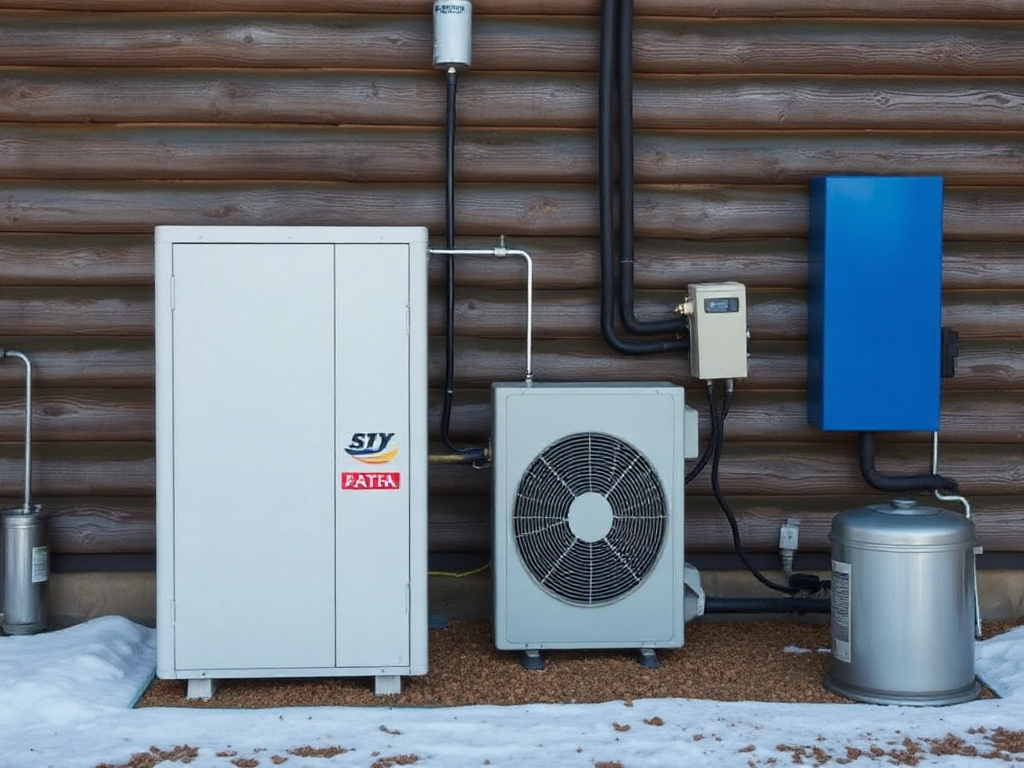
Heat pump use with limited off-grid power is workable when the system is treated as a managed electrical load rather than an always-on heating source. The decisive factors are the heat pump’s startup and running demand, cold-weather efficiency, battery usable capacity, inverter surge rating, and the home’s heat-loss rate. Schedule heating during strong generation periods when practical, protect battery reserve for overnight loads, and use a low-energy backup such as a wood stove or resistance heater only when necessary. Oversizing the heat pump, ignoring defrost cycles, or measuring only its average wattage can cause inverter trips and depleted batteries. A short monitored trial in the coldest expected conditions reveals whether the system fits the available power.
Match Heat Pump Demand to the Off-Grid Electrical System
A heat pump converts electricity into moving heat, but its electrical demand changes with outdoor temperature, indoor setpoint, compressor speed, fan operation, and defrosting. That variability matters more in an off-grid home than in a utility-connected house because the battery, inverter, and generation equipment must absorb every change in load. A unit that looks modest on its nameplate may still create a difficult combination of sustained consumption and short surges.
Begin with the heat-loss requirement, then examine the electrical specifications for the exact model. Separate three values: normal running input, maximum input, and any auxiliary or emergency resistance-heater demand. Resistance elements can draw far more power than the compressor and may overwhelm a small inverter even when the heat pump itself is manageable. A ductless mini-split without electric backup may fit a constrained system more easily than a central unit with a large supplemental heater, although the right choice depends on room layout and climate.
Battery calculations should use usable energy rather than the battery’s advertised capacity. For example, a 2-kilowatt load operating for five hours consumes about 10 kilowatt-hours before accounting for inverter losses and other household loads. If the same home must preserve energy for refrigeration, water pumping, communications, and overnight lighting, the heat pump cannot claim the full battery budget. Heat pump use with limited off-grid power succeeds when heating is assigned a defined share of the system rather than allowed to consume whatever remains.
Check the inverter’s continuous rating, surge capability, low-voltage cutoff, and compatibility with the heat pump’s electrical controls. A variable-speed compressor may have a gentler start than an older fixed-speed model, but that does not eliminate the need to verify actual specifications. A common failure is sizing the inverter for average wattage while overlooking maximum current, defrost operation, or a connected resistance heater. Record power at the service or circuit level during startup, steady operation, and defrost; those observations are more useful than assumptions based on marketing labels.
Reduce Heating Load Before Adding More Generation
Lowering the building’s heat loss is usually more effective than trying to power an inefficient heating pattern with additional panels or batteries. Air leakage, weak attic insulation, unsealed penetrations, poorly fitted doors, and exposed ductwork increase the hours the compressor must run. A heat pump cannot compensate economically for heat leaving through the envelope faster than the system can replace it.
Prioritize improvements according to the building’s actual losses. Weatherstripping a frequently used exterior door may be inexpensive and immediately noticeable, while insulating a long run of ductwork in an unheated crawlspace may prevent both heat loss and condensation concerns. Window coverings can reduce nighttime losses, but they should not block required ventilation or create moisture problems. In a small cabin, concentrating occupied rooms and closing unused spaces may reduce demand; in a larger home, that strategy can produce cold surfaces and uneven temperatures if the system was designed for whole-house circulation.
Thermostat settings also affect runtime. A large nighttime setback may save energy in some buildings, yet recovering from a deep setback during a cold, low-generation morning can create a sharp electrical demand. A smaller setback or a steady lower temperature may be easier for a limited system to support. The best choice depends on thermal mass, insulation, outdoor conditions, and whether the heat pump has to activate supplemental heat during recovery.
Consider a well-insulated room that needs modest heat for several hours versus a drafty structure with the same floor area. The first may coast through short periods of low solar production; the second may run continuously while still feeling uncomfortable near exterior walls. Adding battery capacity to the drafty building treats the symptom, not the cause. Use an energy monitor and a simple temperature log to compare indoor temperature, outdoor temperature, runtime, and battery state. Heat pump use with limited off-grid power becomes more predictable after the building’s demand has been measured rather than estimated.
Operate the Heat Pump Around Battery and Weather Limits
Limited generation calls for deliberate operating rules. The heat pump should generally do more work when renewable generation is available and the battery is healthy, while overnight operation should be limited by a reserve threshold selected for the household’s critical loads. This is not a reason to let the home become cold; it is a method for preventing heating from silently consuming the energy needed for water, food storage, and communications.
During a sunny winter day, raising the indoor temperature slightly may store a small amount of heat in the building’s furnishings and structure. That approach is useful only within reasonable comfort and humidity limits. It is not a substitute for adequate battery capacity because walls and furniture store far less usable energy than a battery. On cloudy days, a stable lower setpoint may be safer than repeatedly calling for high output. Avoid frequent manual cycling, which can produce uncomfortable swings without reliably reducing consumption.
Cold weather creates two separate problems. Heat pumps generally work harder as outdoor temperatures fall, and the system may periodically enter defrost mode to clear ice from the outdoor coil. Defrost temporarily changes the energy pattern and may reduce delivered heat while consuming electricity. If the unit has an electric crankcase heater, pan heater, or backup element, those loads may continue or activate when the owner does not expect them. Read the installation manual for the model’s low-temperature operating range and disable or limit auxiliary functions only when the manufacturer permits it and safe operation is preserved.
A practical control plan can be simple:
- Set a minimum battery reserve for essential circuits before allowing extended heating.
- Record heat-pump input during normal operation and one defrost event.
- Use generation forecasts as a planning aid, not a promise of available energy.
- Inspect filters and outdoor airflow before blaming the battery system for rising demand.
The common mistake is focusing on daily average energy while ignoring the worst three or four hours. A system may balance over 24 hours yet fail during a cold night when solar input is absent and the compressor runs continuously. A second mistake is assuming a smart thermostat will solve a supply shortage; automation can enforce limits, but it cannot create heat or battery capacity.
Choose Backup Heat and Verify the System in Winter
A limited-power home needs a backup heat plan that is independent enough to protect occupants when the electrical system reaches its reserve limit. The backup does not necessarily need to heat every room to the same temperature. Its purpose may be protecting plumbing, maintaining one occupied zone, or carrying the home through a short weather event while the heat pump remains off.
Resistance heaters are straightforward but electrically expensive: nearly all input electricity becomes heat, so a 1,500-watt heater uses 1.5 kilowatt-hours for each hour of operation. That makes a portable or built-in resistance unit useful for brief, supervised recovery but risky as a routine solution on a small battery bank. A properly installed wood stove can reduce electrical dependence, though it brings combustion, chimney, clearance, fuel-storage, ventilation, and carbon-monoxide safety requirements. A propane appliance may provide another option, but fuel availability, venting, and manufacturer instructions must be evaluated carefully.
Choose backup heat by the failure you are trying to cover. For an overnight battery shortfall, a manually controlled appliance in one safe living area may be adequate. For a prolonged cloudy period, stored fuel may be more dependable than a larger electric heater. For freeze protection, pipe insulation and a planned low-temperature shutdown procedure can reduce the amount of heat required. Never use an unvented combustion appliance as an improvised substitute for a permanently installed heating system without addressing indoor-air and carbon-monoxide risks.
Commission the arrangement before the coldest season. Test the heat pump under realistic conditions, observe inverter behavior, confirm that low-voltage cutoffs do not interrupt essential equipment, and verify that backup heat can be started without creating a dangerous electrical or ventilation condition. A short trial should answer practical questions: How many hours does the battery last at the chosen setpoint? Does defrost cause a noticeable voltage drop? What happens when a pump or refrigerator starts at the same time? Heat pump use with limited off-grid power is ready for winter only when those interactions have been observed.
Build a Simple Operating Decision for Real Conditions
The most useful plan links heat-pump operation to three measurements: indoor temperature, battery state of charge, and expected generation. Outdoor temperature adds valuable context because a falling temperature often signals longer runtime and more frequent defrosting. A dashboard that shows only battery percentage can mislead if the battery monitor is poorly calibrated or if a large load causes voltage sag.
Set operating bands rather than a single rigid rule. At a high state of charge with meaningful generation, normal comfort heating may be reasonable. In a middle band, reduce unnecessary temperature recovery and suspend discretionary electrical loads. Near the reserve threshold, maintain only the occupied zone or freeze-protection temperature and prepare the non-electric backup. Exact thresholds should reflect battery chemistry, manufacturer limits, critical household loads, and the reliability of the generation forecast.
Use a written priority order so decisions are made before a crisis. A sensible sequence is:
- Protect people, plumbing, and any equipment that must remain powered.
- Maintain a moderate occupied-zone temperature while generation or stored energy allows.
- Stop auxiliary resistance heat unless it is specifically needed and the inverter can support it.
- Switch to the planned backup source before the battery reaches its emergency cutoff.
Review the plan after actual cold-weather operation. If the heat pump reaches its limit while the battery remains healthy, the building or distribution system may be the constraint. If the battery empties despite mild indoor conditions, electrical demand or charging capacity may be undersized. If comfort varies sharply from room to room, airflow and heat distribution deserve attention before purchasing more storage. The goal is not maximum heat-pump runtime; it is dependable warmth without sacrificing the off-grid system’s essential functions.
For equipment-specific operating limits, defrost behavior, auxiliary-heater controls, and electrical requirements, consult the heat pump manufacturer’s installation and owner documentation, then compare those requirements with the inverter and battery manufacturer’s published limits. Local building and fire-safety authorities can also clarify requirements for wood, propane, or other combustion backup systems.
Frequently Asked Questions
Can a heat pump run from a small off-grid battery?
It may, if the heat pump’s running and startup demands fit the inverter and the battery has enough usable energy for heating plus essential loads. A short measured trial is more reliable than nameplate wattage alone.
Why does a heat pump use more power in freezing weather?
Lower outdoor temperatures reduce the heat available to extract, so the compressor may run longer or at higher output. Defrost cycles and auxiliary heaters can add further demand.
Should the heat pump be turned off at night?
Not automatically. A modest setback may preserve energy, but a deep setback can create a large morning recovery load. Compare steady lower operation with setback during actual cold-weather tests.
Is electric resistance heat suitable as off-grid backup?
It can cover a short emergency period or one small zone, but its direct electrical demand is high. Confirm inverter capacity and battery reserve before using it.
What should be checked when the battery drains unexpectedly?
Check actual heat-pump input, defrost and auxiliary-heater activity, filter condition, outdoor coil airflow, thermostat recovery settings, inverter losses, and simultaneous household loads.
Further Reading
Authoritative Sources
- Academy of Nutrition and Dietetics
eatright.orgProfessional nutrition guidance, healthy eating resources, and practical dietitian-reviewed advice.
- U.S. Department of Agriculture
usda.govOfficial food, nutrition, agriculture, and consumer guidance from the USDA.
- NIH Office of Dietary Supplements
ods.od.nih.govResearch-based fact sheets on nutrients, supplements, dietary intake, and safety considerations.
- International Society of Sports Nutrition
sportsnutritionsociety.orgEvidence-informed sports nutrition resources and position stands for active people and athletes.
Conclusion
A heat pump can fit a limited off-grid power system when its demand is measured, the building’s heat loss is reduced, and operation is tied to battery reserve and expected generation. Give particular attention to maximum electrical input, cold-weather runtime, defrost cycles, and any resistance heating hidden in the system. Use monitoring to identify whether the weak point is the heat pump, inverter, battery, generation equipment, or building envelope. Then establish a backup plan before winter, with safety requirements suited to the chosen fuel and appliance. The next step is a controlled cold-weather test: log power, temperature, runtime, and battery state through a full heating cycle. Those observations provide the evidence needed to adjust settings, improve insulation, or expand the electrical system without guessing.