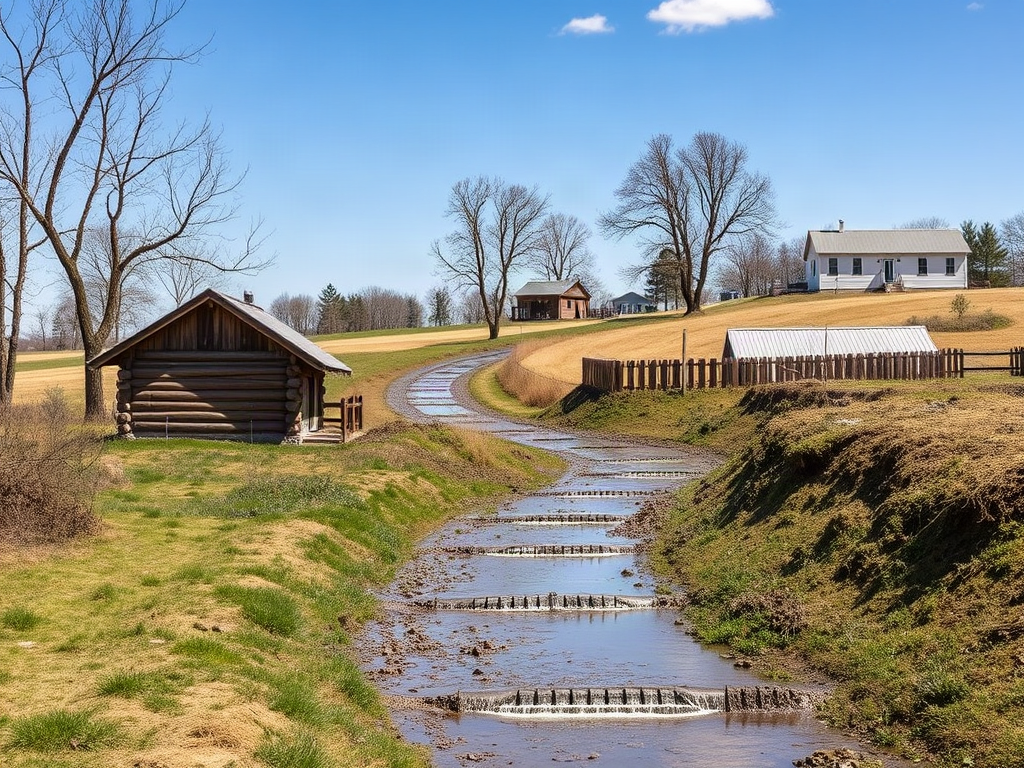
Flood drainage planning for self-sustainable homesteads should keep runoff away from homes, wells, animal areas, food gardens, and access routes by matching swales, berms, culverts, infiltration areas, and overflow paths to the land’s slope and soil. Begin by mapping high ground, low points, roof discharge, seasonal water tables, and the direction of neighboring runoff before digging. Use stable outlets rather than sending concentrated flow toward a property line or septic area, and reserve a visible overflow route for storms that exceed the design. Check every drain after heavy rain for erosion, sediment blockage, standing water, and undercut banks; these signs show whether the layout is protecting the homestead or merely moving the problem downstream.
Read the Site Before Choosing Drainage Features
Drainage decisions should follow the movement of water across the property, not the popularity of a particular earthwork. A homestead may receive runoff from roofs, compacted driveways, upper slopes, neighboring land, springs, and saturated soils. Each source behaves differently. Roof water arrives quickly and in concentrated outlets, while hillside sheet flow may spread across a broad area. A shallow seasonal water table may leave a ditch full even when no storm is occurring.
Begin with a simple site survey during both dry weather and rain. Mark building foundations, wells, septic components, garden beds, livestock shelters, roads, ponds, drainfield areas, and existing low points. Use a builder’s level, laser level, or carefully checked contour measurements to identify where water enters, where it gathers, and where it can leave without crossing vulnerable areas. The goal is not perfect engineering data; it is a reliable picture of elevation and flow direction.
Walk the property during a substantial storm if conditions are safe. Look for water that bypasses an existing ditch, ponding beside structures, muddy channels forming through garden soil, and culverts that surcharge. A depression that appears harmless in summer can become the main route for stormwater after frozen or saturated ground removes infiltration capacity.
Do not assume that the lowest point is automatically a suitable outlet. It may contain a well, septic field, wetland, neighbor’s property, or unstable bank. A low area can also become a mosquito-producing pond or remain too wet for equipment access. Compare a dispersed infiltration approach with a defined conveyance route: infiltration reduces downstream flow when soil and groundwater conditions allow it, while conveyance offers more predictable movement but concentrates erosion risk.
Keep a working map and add observations after each major storm. The Flood drainage planning for self-sustainable homesteads record becomes more valuable when it documents dates, rainfall intensity, blocked points, and repairs rather than only drawing permanent features.
Separate Runoff Sources and Protect Critical Areas
Runoff should be handled according to the damage it could cause, not simply according to its volume. Clean roof water may be suitable for storage or controlled infiltration, whereas water passing over a manure yard can carry pathogens and nutrients toward a creek, well, or vegetable plot. A drainage layout that combines every flow path may be easy to dig but difficult to keep safe.
Protect buildings first. Grade the finished ground so surface water moves away from foundations, then discharge downspouts far enough from walls to avoid creating a saturated trench beside the footing. Where soil erodes easily, use a stable splash area, rock-lined channel, or buried conveyance designed for inspection and cleaning. Avoid burying an outlet where a hidden failure could saturate the foundation unnoticed.
Wells and septic systems deserve separate attention. Keep stormwater from flowing toward the wellhead, and do not use a septic drainfield as a convenient stormwater absorption zone. Saturating a drainfield can reduce its ability to accept wastewater and may cause surfacing or backflow. Local health and building authorities may set setbacks or requirements, so the site plan should be checked before excavation.
Food gardens need a different balance. A drainage ditch through productive soil may remove water quickly but also strip topsoil and nutrients. A broad, grassed swale above the garden can spread sheet flow and reduce the speed entering the beds. Raised beds, deep-rooted perennial plantings, and organic matter may improve short-duration infiltration, but they cannot compensate for an uphill catchment delivering a large concentrated flow.
Animal areas require attention to muddy gateways, roof runoff, and contaminated wash water. Divert clean water around a barnyard instead of allowing it to mix with manure-laden runoff. Stabilize high-traffic surfaces with appropriate aggregate or durable footing, and provide a route that remains usable when the surrounding ground is saturated. A common failure is treating a livestock lane as temporary; repeated traffic can create a compacted channel that sends fast runoff directly toward a creek or shelter.
Use the homestead drainage layout as a protection hierarchy: foundations and drinking water first, wastewater and food production next, then roads, storage areas, and landscape improvements.
Match Swales, Berms, Culverts, and Outlets to the Land
Swales, berms, culverts, drains, and infiltration basins each solve a different hydraulic problem. A swale is a shallow depression that can slow and spread runoff; a berm is raised soil that redirects or temporarily holds it. Neither feature should be installed as a level-looking trench without confirming where excess water will go. A swale that fills beyond its stable edge can breach suddenly and send erosive flow toward a house or garden.
On a gentle slope with permeable soil, a broad vegetated swale may reduce runoff speed and allow some water to infiltrate. On compacted clay, shallow groundwater, or a steep grade, the same shape may remain wet and become an uncontrolled channel. In those conditions, a lined or reinforced conveyance route may be safer than relying on infiltration. The tradeoff is that hardening a channel can move water faster and increase the need for a properly designed outlet.
Culverts are useful where a driveway or road crosses a natural flow path, but undersized or poorly aligned pipes are common failure points. Water may overtop the road, erode the inlet, or bypass the pipe along the fill. Clear debris from the entrance, protect the inlet from scour, and ensure the outlet does not discharge onto bare soil. A larger pipe is not automatically a complete solution if the entrance, slope, or downstream channel cannot handle the flow.
Outlets need as much design attention as the uphill collection feature. Release water onto stable vegetation, rock, or another erosion-resistant surface, and avoid aiming concentrated flow at a property boundary, pond bank, septic area, or unprotected stream edge. Where water must cross a slope, use grade-control measures that reduce velocity rather than creating a single steep chute.
A practical sequence is to work from the source outward:
- Reduce unnecessary runoff with soil cover, permeable surfaces, and roof-water storage where appropriate.
- Intercept or spread manageable sheet flow before it reaches buildings or production areas.
- Convey unavoidable flow through stable, inspectable routes.
- Discharge or infiltrate it at a location that remains safe during soil saturation.
The mistake to avoid is digging first and observing later. Earth moved without a confirmed outlet can create a larger watershed problem, especially when a berm blocks a historic drainage path or a ditch concentrates water beyond the property’s original pattern.
Build Maintenance and Overflow Into the Design
Flood drainage is an operating system, not a one-time landscaping project. Leaves, sediment, ice, roots, livestock, fallen branches, and vehicle traffic can reduce capacity long before a major storm arrives. A design that works only when every inlet is clean and every bank is intact is not resilient enough for a self-sufficient property.
Inspect drainage features at predictable times: before the wet season, after prolonged dry weather that may hide cracking or settlement, and after heavy rainfall. Check whether grass cover is continuous, whether rills are enlarging, whether sediment is filling a swale, and whether water is emerging beneath a berm. At culverts, inspect both ends and the road fill above the pipe. At basins, verify that the emergency overflow remains open and leads to a stable area.
Signs of a functioning system include water spreading or moving without deepening channels, dry foundations after storms, passable access routes, and no new sediment deposits in wells, gardens, or ponds. Warning signs include cloudy well water, standing water near a septic field, exposed pipe, slumping banks, fresh gullies, and water overtopping a road. These observations should trigger correction before the next large storm rather than being dismissed as normal wear.
Every detention area, pond, or berm needs a deliberate overflow route. The overflow should be visible, vegetated or otherwise stabilized, and directed away from occupied structures. A hidden low spot is not an emergency spillway. During an unusually intense storm, controlled overflow is preferable to an unexpected breach that removes soil and exposes foundations.
Maintenance also affects self-sufficiency. Keep a shovel, hand tools, replacement culvert grates where appropriate, gravel, seed, erosion-control materials, and safe access to inspection points. Avoid designs that require specialized machinery for every minor repair. A compact, inspectable swale may be more practical than a buried system that performs well but cannot be diagnosed without excavation.
Use runoff maintenance checks to update the plan after land-use changes. A new barn, greenhouse, driveway, pond, or cleared slope can alter the catchment and invalidate an older drainage route.
Use a Priority Order Before Excavating
A phased approach prevents limited labor and materials from being spent on cosmetic grading while critical risks remain. The first priority is identifying immediate threats to people, foundations, drinking water, and wastewater systems. The second is preserving access and food production. Landscape ponds, decorative channels, and additional storage can wait until the basic flow network is stable.
For a small homestead, document the following before hiring equipment or moving soil:
- Where stormwater enters and exits the property.
- Which assets cannot tolerate flooding or prolonged saturation.
- Which routes are natural, which are man-made, and which have already eroded.
- Where water can be slowed, stored, infiltrated, or safely released.
- What will happen when the chosen feature is blocked or exceeded.
Start with low-risk corrections such as cleaning existing culverts, extending downspouts, restoring ground cover, and removing obstructions from established flow paths. Then address grading or conveyance near buildings. Larger ponds, deep excavations, retaining structures, and work near streams may require experienced design and local approval because failure can affect neighboring land as well as the homestead.
Do not confuse visible water storage with flood control. A pond may fill during a storm but still have an unsafe outlet, leak through an embankment, or reduce downstream capacity when already full. Likewise, a French drain may perform well for shallow seepage but fail when asked to carry concentrated stormwater. Choose features according to the water source and failure consequence.
After each improvement, observe the next storms and record what changed. If water arrives more quickly, erosion moves downstream, or a previously dry area stays saturated, revise the system rather than adding another disconnected ditch. Good planning is incremental: protect critical assets, preserve stable flow, test the result, and expand only when the outlet and overflow behavior are understood.
Frequently Asked Questions
Should a homestead drain all stormwater away as quickly as possible?
No. Fast conveyance can increase erosion and downstream flooding. Slow, spread, or infiltrate clean runoff where soil, groundwater, and outlet conditions make that safe.
Where should roof downspouts discharge?
Discharge them away from foundations and toward a stable vegetated, rocked, stored, or infiltrating area that does not threaten wells, septic components, gardens, or neighboring land.
Are swales suitable for every homestead?
No. Swales may work on moderate slopes with suitable soil and a safe overflow, but saturated clay, shallow groundwater, steep grades, or large catchments may require reinforced conveyance.
How can I tell whether a culvert is failing?
Look for road overtopping, erosion at either end, sediment blocking the inlet, water bypassing the pipe, exposed sections, or settlement above the culvert after storms.
What should be protected first during drainage upgrades?
Prioritize people, foundations, drinking-water sources, septic systems, and emergency access. Address gardens, animal areas, and long-term landscape improvements after those risks are controlled.
Further Reading
Authoritative Sources
- USDA Natural Resources Conservation Service: Soil Erosion
nrcs.usda.govProvides context on erosion processes, soil cover, and conservation practices relevant to runoff control
- U.S. Environmental Protection Agency: Green Infrastructure
epa.govExplains approaches that slow, store, and infiltrate stormwater through landscape-based systems
- FEMA Flood Maps
fema.govHelps property owners review mapped flood hazards before placing buildings or major drainage works
Conclusion
Reliable homestead drainage comes from reading the whole catchment and planning for failure, not from installing the largest ditch or pipe. Map incoming runoff, low points, soil behavior, seasonal saturation, and vulnerable assets before changing grades. Keep clean roof water separate from contaminated yard flow, protect foundations and wells first, and give every swale, basin, berm, and culvert a stable outlet plus a visible overflow route. Begin with maintenance and small corrections, then use observed storm behavior to decide whether larger earthworks are justified. A drainage feature is doing its job when it reduces ponding and erosion without transferring the hazard to a septic field, stream, road, or neighboring property. Reinspect after major storms and revise the layout as buildings, roads, and cultivated areas change.