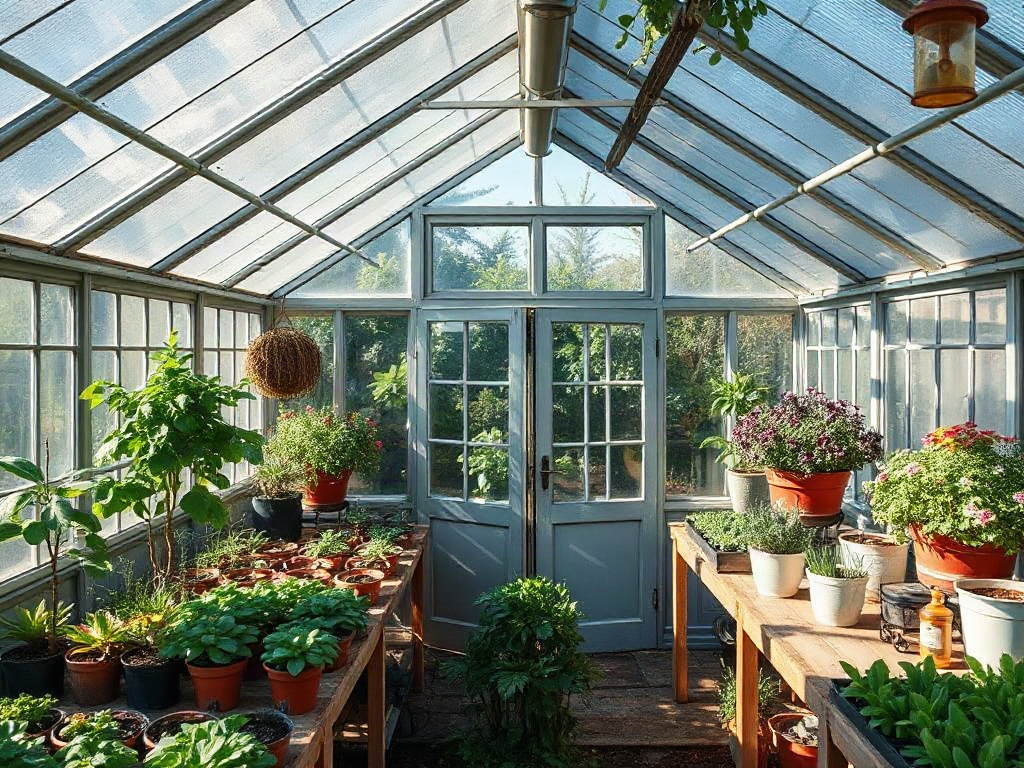
A beginner greenhouse should be large enough for full-grown plants and a workable aisle, glazed for the site’s wind, snowfall, sunlight, and budget, and ventilated through both low-level air inlets and high-level exhaust openings. Choose usable growing area rather than exterior dimensions alone, because benches, doors, water containers, and access quickly consume floor space. Polycarbonate usually offers better impact resistance and heat retention than single-pane glass, while polyethylene film provides a lower-cost but shorter-lived enclosure. Vent openings, circulation fans, shade, and automatic openers control heat and humidity; relying on an open door alone commonly leaves hot, stagnant pockets around the crop.
Choose Size From Usable Growing Space
Greenhouse dimensions should follow the plants, working aisle, and equipment that must fit inside—not simply the largest structure that fits the yard. Mark the proposed footprint with stakes and string, then lay out benches or beds at their actual widths. Walk through the marked aisle carrying a watering can, tray, or bucket. This simple test exposes cramped corners and blocked door swings before a frame is purchased.
A narrow structure may suit seed trays or a single row of compact crops, but mature tomatoes, cucumbers, and climbing beans occupy far more volume than seedlings. Their foliage can extend into the aisle and restrict airflow. A person planning two side benches must account for both bench depth and a central path wide enough for comfortable watering, pruning, and harvesting. Wheelbarrow or cart access requires additional width, as does turning space near the door.
Exterior measurements can be misleading because sloping walls, frame braces, and low eaves reduce usable volume. Straight sidewalls provide more shoulder room and allow tall crops to grow closer to the perimeter. Headroom also influences temperature: a greater interior air volume generally heats and cools less abruptly than a very small enclosure, although it takes more energy to heat during cold weather. Extra length usually adds productive area more efficiently than awkward width, provided ventilation can still move air from one end to the other.
Beginners often buy for the number of plants they own today and omit staging space. Seed-starting trays, potting mix, tools, hoses, heaters, and rain barrels compete with crops for room. Storage inside a humid structure can also obstruct air movement and damage items that should remain dry. Reserve greenhouse space for cultivation and keep bulk supplies elsewhere when possible.
A practical layout calculation should include:
- Crop footprint: use mature spacing and expected plant height, not pot size at purchase.
- Access: leave a continuous route to every bed, vent, window, and utility connection.
- Work area: allow space for transplanting, pruning, and setting down harvested produce.
- Future use: include modest expansion without buying a structure too costly to glaze, anchor, or heat.
A compact greenhouse can be the sensible choice for propagation and seasonal protection. A larger model becomes worthwhile when it improves access or extends crop capacity, rather than merely creating empty air that must be managed. The layout principles in Greenhouses for beginners: choosing size, glazing, and ventilation are best applied on the ground with a measured footprint before comparing kits.
Match the Glazing to Climate and Budget
Glazing controls light transmission, heat loss, impact resistance, maintenance, and much of the structure’s long-term cost. No material wins every comparison. The useful question is which weakness is acceptable at the site: breakage, declining clarity, short service life, condensation, installation complexity, or a higher initial price.
Glass offers lasting clarity and a traditional appearance. It is comparatively heavy, so the frame and foundation must support it, and ordinary panes can break under impact. Seals and overlaps require attention because gaps admit cold air. Glass may suit a permanent, well-built structure in a protected location, especially when appearance matters, but it is less forgiving where falling branches, hail, or frequent ball play are realistic hazards.
Multiwall polycarbonate contains internal air channels that reduce heat transfer compared with a single thin layer. Its impact resistance makes it practical for exposed gardens, and its lighter weight simplifies some installations. The sheets must be oriented so the channels drain correctly, their ends need appropriate sealing, and the ultraviolet-protected face must point outward when specified by the manufacturer. Incorrect installation can trap dirt or algae inside the channels and shorten useful life. Thicker panels are not automatically compatible with every kit; frame grooves, fasteners, and bending limits must match the selected sheet.
Greenhouse-grade polyethylene film is usually the lowest-cost route to enclosing a frame. It works well for seasonal structures and growers testing whether protected cultivation fits their routine. Film is vulnerable to puncture, abrasion, and wind damage, however, and it eventually requires replacement. Loose covering repeatedly rubbing against a frame can fail early. Proper tension, smooth contact points, suitable fastening channels, and prompt repair matter more than simply buying a heavy roll. Household plastic sheeting should not be assumed to perform like film manufactured for greenhouse exposure.
Clear material is not the only useful choice. Diffused glazing scatters incoming light, reducing sharp shadows and distributing light farther through a dense canopy. That can be helpful for benches or tall crops, although every product differs in transmission and haze. Dirty glazing, surface condensation, labels, and aging can further reduce available light, so compare manufacturer specifications rather than judging a small sample by eye.
Choose glazing only after checking the local wind and snow demands, frame compatibility, replacement availability, and fastening method. A cheap covering that must be replaced awkwardly over established beds may cost more in labor and crop disruption than expected. Conversely, premium glazing is difficult to justify on a temporary frame or a poorly drained, unanchored site.
Build Ventilation Around Heat and Humidity
Ventilation must remove heated air while replacing it with cooler outside air across the growing area. Solar radiation can raise the interior temperature even when outdoor conditions feel mild. Warm air rises, so roof vents or high wall vents provide an efficient escape route; lower openings admit replacement air. An open door at one end may cool the entrance while leaving the opposite end and upper canopy dangerously hot.
Natural ventilation works through buoyancy and wind pressure. High and low openings on different parts of the structure create a path rather than a single outlet. Automatic wax-cylinder vent openers can respond to temperature without electricity, making them useful when nobody is present during a sudden sunny period. Their opening force, temperature adjustment, mounting geometry, and wind exposure need to match the vent. They are not substitutes for checking that a vent moves freely and cannot be damaged by gusts.
Powered exhaust is useful where natural openings are limited or summer heat is persistent. An exhaust fan should discharge high on one end while adequately sized intake shutters admit air from the other. If the intake is too small, the fan works against excessive resistance, airflow falls, and doors may slam or become difficult to open. Household room fans are better treated as circulation devices than as complete exhaust systems unless they are specifically suitable for the damp location and arranged to exchange indoor air with outdoor air.
Internal circulation serves a different purpose. A gentle horizontal air pattern reduces stagnant pockets around leaves, evens temperature differences, and helps wet foliage dry. Leaves should move slightly rather than whip continuously. Strong airflow aimed at seedlings can dry trays unevenly, while a fan blowing hot roof air directly downward can worsen plant stress. Electrical equipment and connections used in a wet greenhouse should be suitable for the environment and installed with appropriate protection.
Temperature alone does not reveal whether ventilation is working. Persistent condensation, a musty smell, algae spreading on surfaces, slow drying after watering, or disease repeatedly appearing in dense foliage can indicate inadequate air exchange or poor irrigation timing. Wilting at midday despite moist soil, scorched leaf edges, and sharply hot air near the roof suggest excess heat. Shade cloth can reduce solar gain, but it does not remove humidity or replace fresh-air exchange.
Test the completed system on a bright day before filling every bed. Check conditions at plant height and near the far end, not only beside the door. The ventilation discussion within Greenhouses for beginners: choosing size, glazing, and ventilation should be treated as an operating plan: vents must be accessible, fans unobstructed, and automatic equipment checked through the season.
Use a Site-to-Setup Checklist Before Buying
A sound greenhouse can perform poorly on a shaded, wet, windy, or inaccessible site. Observe the proposed area across the day and, if possible, across seasons. Winter shadows extend farther than summer shadows, while deciduous trees can change both light and branch-fall exposure. Prioritize useful sunlight during the intended growing months rather than assuming maximum sun is always desirable; an intensely exposed summer site may demand substantial shading and ventilation.
Drainage affects both the structure and daily work. Water flowing through the site can undermine an inadequately prepared base, keep paths muddy, and drive humidity upward. The finished floor should remain level and usable, with surface water directed away rather than trapped against framing. A level, square base also helps doors close correctly and glazing panels seat without distortion. Anchoring must suit the frame, ground conditions, and wind exposure; the glazing can act like a large sail even when every door is shut.
Utilities deserve early attention. A nearby water source reduces the temptation to drag hoses across doors or pathways. Any electrical supply for fans, heaters, lights, or controls should be planned for wet conditions rather than improvised with indoor extension cords. Heating changes the economic calculation because heat escapes through glazing and air leaks. A greenhouse used only for frost protection has different sealing and equipment needs from one intended to hold warm-season temperatures through winter.
Before ordering, complete this compact sequence:
- Define the season and crops. Decide whether the structure is for seed starting, summer production, shoulder-season extension, or cold-weather growing.
- Measure the usable layout. Draw mature plants, benches, paths, door clearance, vents, and equipment to scale.
- Inspect the site. Record sun, shade, drainage, prevailing wind, overhead hazards, and access for materials.
- Match the enclosure. Confirm glazing thickness, fasteners, frame loading, panel orientation, and replacement availability.
- Plan heat control. Locate low inlets, high outlets, automatic openers, exhaust equipment, circulation fans, and seasonal shade.
- Verify local requirements. Check applicable property setbacks, utility locations, permissions, and structural requirements before ground work.
A common purchasing mistake is spending the full budget on the frame and panels. Base preparation, anchors, vent openers, fans, benches, irrigation fittings, thermometers, shade material, and delivery can materially change the installed cost. Compare complete operating setups rather than kit prices. A smaller structure with reliable anchoring and heat control is usually more usable than a larger enclosure that cannot be ventilated, reached with water, or kept square.
Frequently Asked Questions
What greenhouse size is suitable for a first-time grower?
Choose the smallest footprint that accommodates mature crops, a comfortable aisle, door clearance, and a work surface. Marking the layout outdoors is more reliable than choosing from plant count alone.
Is polycarbonate or glass better for a beginner greenhouse?
Polycarbonate is often easier to handle and more impact-resistant, while glass offers durable clarity and a traditional finish. The frame, climate exposure, installation method, and replacement cost should decide between them.
Can opening the greenhouse door provide enough ventilation?
A door alone rarely creates even airflow through the entire structure. Pair low-level inlets with high vents, and add exhaust or circulation fans where natural airflow leaves hot or stagnant zones.
Does a greenhouse need shade cloth?
Shade may be useful during intense sunny periods when ventilation cannot keep temperatures manageable. It reduces incoming solar energy but does not replace air exchange or correct excessive humidity.
Where should a greenhouse be placed?
Select a level, well-drained location with suitable seasonal sunlight, manageable wind exposure, safe distance from falling branches, and convenient access to water. Confirm local placement requirements before building.
Conclusion
A dependable first greenhouse is designed from the inside outward. Draw the mature crop layout, preserve comfortable access, and leave room to operate vents and equipment before settling on exterior dimensions. Select glazing whose weight, durability, insulation, and fastening requirements suit both the frame and local exposure. Then create a complete airflow path using intake openings, elevated outlets, and circulation where needed.
Walk the proposed site during different light and weather conditions, test drainage, and price the base, anchors, controls, shade, water access, and electrical work alongside the kit. Once assembled, monitor several locations at plant height on sunny and cool days. Uneven temperatures, persistent condensation, trapped odors, or wet foliage show where the setup needs adjustment before valuable plants fill the space.