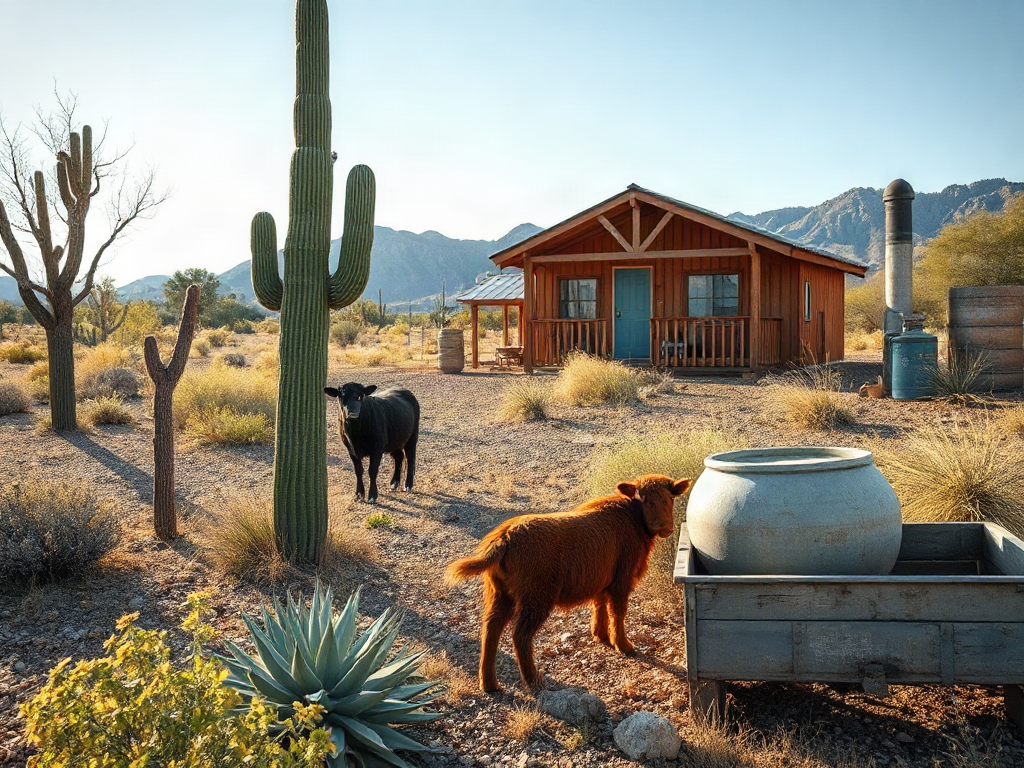
Choose Land by Water Reality, Not Acreage
Arizona parcels that look similar on a listing can have radically different operating costs. A property served by a functioning well, a regulated water provider, or a practical hauling route is not equivalent to land where the buyer merely hopes groundwater is accessible. Before considering barns, orchards, or animals, identify the legal and physical source of every gallon the homestead would use.
For a well, request the available drilling log, construction details, depth, pump information, and recent production or recovery observations. A well’s existence does not establish that it can meet a household and agricultural load. Water level, pumping performance, water quality, equipment condition, electrical demand, and nearby groundwater trends all affect usefulness. A low-producing well may still serve a restrained household if storage allows it to pump slowly, but it may be unsuitable for irrigating a large summer garden.
Hauled water changes the calculation rather than solving it. Check the distance and road between the property and the filling point, the seller’s operating schedule, vehicle payload limits, tank unloading method, and whether access remains usable during storms. Repeated trips consume time, fuel, and vehicle capacity. Delivery may be easier, but availability and price can change. Storage should provide a practical buffer without allowing water to stagnate or sit in sun-exposed plumbing.
Rainfall should be treated as a variable supplement, not an assumed year-round supply. Roof catchment can capture valuable stormwater, yet annual totals do not reveal the long dry intervals between storms. Collection also depends on roof area, losses, tank capacity, intended use, and safe conveyance. Water intended for drinking requires more stringent material, treatment, testing, and maintenance decisions than water sent to landscape basins.
Land-use restrictions deserve equal attention. County requirements, zoning, floodplain conditions, septic approval, building permits, well rules, and any subdivision covenants may shape what can be built or kept. Confirm details with the agencies responsible for the specific parcel; Arizona’s rural conditions and local requirements are not uniform. The common mistake is pricing land first and water second. Reverse that order: document the source, delivery path, storage, quality, and backup before deciding whether the acreage is affordable.
Build a Measurable Household Water Budget
A workable water budget assigns demand to people, crops, animals, sanitation, and unavoidable losses. Guessing from a monthly bill elsewhere can be misleading because irrigation, tank leakage, evaporative cooling, dusty conditions, and livestock troughs introduce uses that an urban household may not have. Start with measured current consumption where possible, then model the proposed homestead during its hottest and driest operating period.
Separate essential demand from expandable production. Drinking, cooking, hygiene, and basic cleaning take priority. Animals need dependable daily water, with demand affected by species, body size, feed, shade, temperature, health, and life stage. Garden demand varies with planted area, soil, crop maturity, irrigation efficiency, and weather. Trees can become a long-term obligation because their root zones and canopy needs grow after the optimistic first season.
A compact planning worksheet should record:
- Source: expected availability, refill rate, quality, and seasonal uncertainty.
- Storage: usable volume rather than nominal tank size, plus reserve capacity.
- Demand: household, each animal group, each irrigated zone, and cooling equipment.
- Delivery: pump output, pipe layout, pressure, energy source, and hauling logistics.
- Losses: leaks, overflow, flushing, evaporation, and water discarded during maintenance.
Metering converts assumptions into operating knowledge. A whole-system meter can reveal unexplained use, while separate readings for a garden line or livestock branch show where expansion is occurring. Marking tank levels and logging deliveries can work where a conventional meter is impractical. A successful budget leaves a reserve after normal peak use. A failing one repeatedly reaches the bottom of storage, requires emergency hauling, or forces plants and animals to compete for the same limited supply.
Greywater may reduce demand on potable supplies when the plumbing, products, soils, crops, and local requirements are appropriate. It is not automatically safe for every use, and storage of untreated greywater can create sanitation problems. Likewise, efficient fixtures cannot compensate for an oversized irrigated landscape. Readers developing a broader Homesteading in Arizona with heat and water limits plan should set a firm production ceiling based on dry-season supply rather than expanding until shortages appear.
Design Gardens for Heat, Wind, and Evaporation
Arizona garden design should control exposure before adding more irrigation. Intense sun, hot wind, dry air, reflective surfaces, and warm soil can drive rapid moisture loss and stress leaves even when roots are not completely dry. The response is not simply frequent shallow watering; that pattern can leave roots near the surface, increase salt concentration problems, and make plants less resilient when a line clogs.
Place growing beds where morning light is available and late-afternoon heat can be moderated. Shade cloth mounted with airflow above the crop is generally more useful than material resting on foliage. Wind filtering can reduce drying, but a solid barrier may create turbulence or trap heat. Mulch limits direct soil evaporation and temperature swings, although it must be managed around stems and inspected where pests are a concern. Compost can improve difficult soil structure, while irrigation should be adjusted to the actual rooting depth rather than a fixed calendar.
Drip irrigation applies water near roots, but it is not maintenance-free. Emitters can clog, fittings can separate, rodents can damage tubing, and unequal pressure can leave distant plants dry. Run the system long enough to wet the intended root zone, then inspect below the surface rather than judging by a damp spot around the emitter. Filtration, pressure regulation, zone valves, flushing points, and routine walk-throughs make a small system more dependable.
Crop selection should reflect both season and water commitment. Heat-tolerant summer crops such as okra, cowpeas, Armenian cucumbers, and some peppers may remain productive under conditions that stop cool-season vegetables. Lettuce, peas, carrots, brassicas, and many leafy greens are usually better matched to cooler planting windows. Variety performance still varies by elevation and local microclimate; low-desert schedules should not be copied unchanged at a higher, colder site.
Start with a few intensively managed beds rather than a broad field. For example, four shaded drip zones near the house are easier to inspect after a hot, windy day than scattered rows at the edge of a parcel. Signs the system is working include moisture reaching the active root area, steady new growth, limited midday stress that recovers by evening, and predictable tank use. Persistent wilt after sunset, dry pockets beside emitters, rising water consumption, blossom loss, or scorched fruit indicates that exposure, irrigation coverage, crop timing, or all three need correction. More water should follow diagnosis, not replace it.
Keep Livestock Within the Property’s Cooling Capacity
Livestock numbers must fit the homestead’s ability to deliver clean water, shade, ventilation, feed, and emergency care during severe heat. Acreage alone is a poor measure of carrying capacity on arid land. Sparse forage may recover slowly, and animals concentrated around water can strip vegetation and compact soil. Unless the parcel has verified forage production and a managed grazing plan, purchased feed may remain the dependable base.
Species and breed choice affect the workload, but no label makes an animal heat-proof. Chickens need ventilated shade and cool, accessible water; closed coops can retain dangerous heat. Goats may tolerate dry environments better than some livestock, yet they still require suitable shelter, fencing, minerals, forage or feed, and adequate water. Rabbits are especially vulnerable to heat and should not be selected merely because their footprint is small. Large stock increases storage, trough, fencing, hauling, manure, and veterinary logistics.
Water systems should be designed around failure. Use trough placement that encourages drinking without forcing animals into full sun, secure lines against chewing and damage, and inspect automatic valves daily. A float valve can hide a leak until a tank empties, while a stuck valve can leave a trough dry. A stored reserve is useful only if there is a gravity path, backup pump, generator arrangement, or other safe means to move it where needed.
Observe animals rather than relying solely on the weather forecast. Reduced feed intake, crowding around water, persistent open-mouth breathing, lethargy, weakness, poor coordination, or failure to settle after heat exposure warrants prompt action and may require veterinary help. Species differ, so owners should obtain heat-response instructions from a veterinarian familiar with their animals before summer.
A sensible first-year approach is to operate the household and garden through peak heat before adding stock, or to begin with a small group whose daily needs can be measured. Compare the water log and labor demand against the reserve. Expansion is justified when troughs stay clean and supplied, shade remains effective through the afternoon, backup delivery works, and feed storage is secure. Adding animals because unused land appears available is a common and expensive mismatch.
Make the Homestead Resilient to Outages and Drought
Resilience comes from separating a routine inconvenience from a system-wide emergency. A grid outage can stop a well pump, disable pressure systems, reduce ventilation, and interrupt refrigeration at the same time that heat raises demand. The homestead should retain essential drinking water and animal access even when its primary pump or power source is unavailable.
Map the system from source to point of use. Identify every pump, valve, filter, controller, exposed pipe, tank outlet, and electrical dependency. Tanks need stable foundations, protected fittings, screened or sealed openings appropriate to their use, and inspection access. Opaque or shaded storage can limit sunlight exposure, but water quality still depends on source conditions, tank hygiene, materials, residence time, and intended use. Drinking-water systems deserve testing and treatment decisions based on qualified local guidance rather than appearance or taste.
Backup power should be sized for the equipment it must start and run; pump starting loads can differ from normal operating demand. Solar pumping may pair well with storage because water can be moved while energy is available, yet it does not remove the need for controls, maintenance, and contingency planning. Gravity delivery can simplify emergency use where site elevation and safe tank placement permit it. A generator offers another option but brings fuel storage, ventilation, maintenance, and manual-start concerns.
Test the plan before the hottest weather. Shut down the primary pump under controlled conditions and confirm how household containers, animal troughs, and critical garden zones will be supplied. Check whether everyone can operate the necessary valves and whether hoses or transfer pumps actually reach their destinations. A paper plan that depends on one person, an untested connector, or a vehicle that may be away is not redundant.
The strongest Homesteading in Arizona with heat and water limits systems also have contraction rules. Decide in advance which annual beds will be left unplanted, which trees receive priority, and when animal numbers must not increase if storage, delivery frequency, or well performance worsens. Warning signs include shorter intervals between fills, declining pump recovery, recurring leaks, livestock water approaching reserve levels, or emergency purchases becoming routine. Responding early costs less than defending an oversized operation through a prolonged dry period.
Frequently Asked Questions
Can an Arizona homestead rely entirely on rainwater?
That depends on roof area, storage, local rainfall pattern, demand, and intended use, but long dry intervals make rainwater risky as the only supply. Model monthly availability and maintain a lawful backup source.
Is hauled water practical for a rural homestead?
It can support a restrained household or small operation when the fill point, road, vehicle, unloading system, and storage are dependable. Long trips and growing livestock or irrigation demand can make hauling costly and time-intensive.
What should be planted in extreme Arizona summer heat?
Okra, cowpeas, Armenian cucumbers, and suitable pepper varieties are possible choices, depending on elevation and microclimate. Use drip irrigation, mulch, airflow, and afternoon protection rather than relying on crop choice alone.
How much water storage does an Arizona homestead need?
Storage should cover measured essential demand through a realistic interruption, with additional capacity for animals and system losses. Calculate the reserve from actual use and refill reliability instead of choosing a tank by acreage.
Which livestock are easiest to keep with limited water?
No livestock should be chosen on low water use alone. Compare daily supply, heat vulnerability, shade, feed, fencing, manure, and veterinary access; a small flock or herd with ample reserve is safer than maximizing animal numbers.
Further Reading
Authoritative Sources
- University of Arizona Cooperative Extension
extension.arizona.eduProvides Arizona-specific material on gardening, livestock, water, soils, climate, and county extension services
- Arizona Department of Water Resources
new.azwater.govOffers official information about Arizona water management, wells, groundwater, conservation, and regional conditions
- Arizona Department of Environmental Quality
azdeq.govExplains state programs related to drinking water, water quality, wastewater, and environmental compliance
- USDA Web Soil Survey
websoilsurvey.nrcs.usda.govHelps readers review mapped soil characteristics before planning gardens, access, structures, or land management
Conclusion
A viable Arizona homestead is defined less by parcel size than by verified water, controlled exposure, and an operation small enough to withstand peak summer demand. Investigate the source and legal constraints before purchase, then meter household, garden, and animal use separately. Build storage and delivery around realistic interruptions rather than average days.
Begin with compact growing areas, seasonal crops, maintainable drip zones, and shade that does not block airflow. Delay livestock expansion until water logs, feed costs, and emergency tests show dependable capacity. The next practical step is a parcel-specific worksheet covering source records, storage, peak demand, pumping, backup delivery, soil, access, and local rules. If any critical item depends on an undocumented assumption, resolve it before committing money to land or permanent infrastructure.