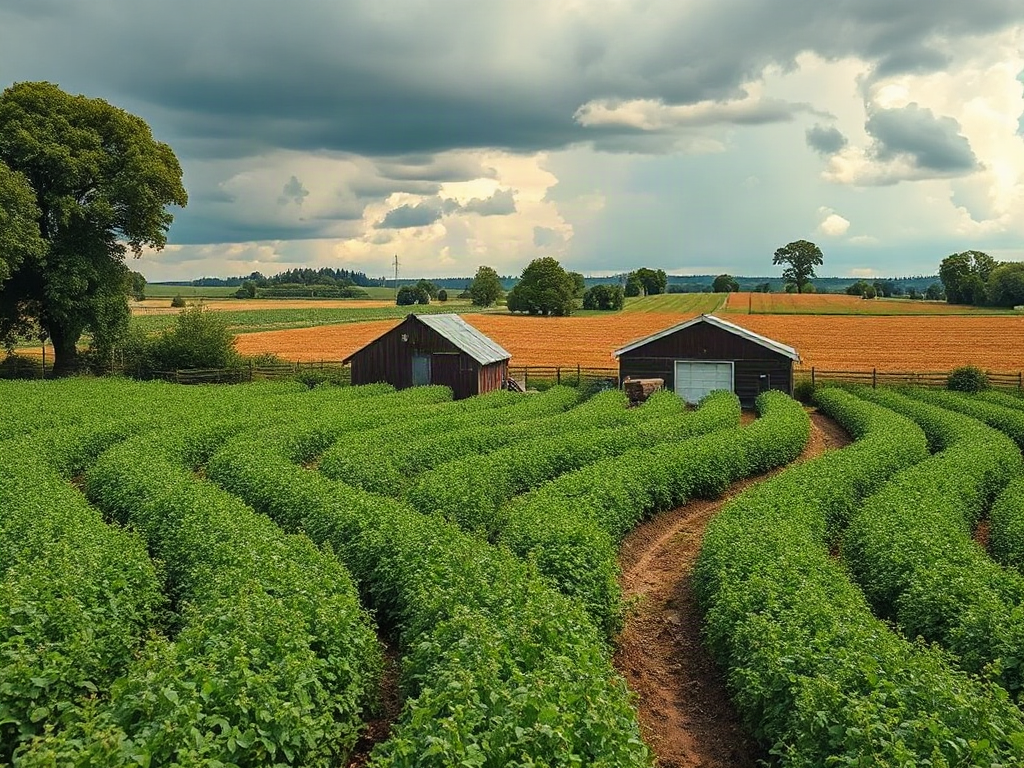
Making a living farming on a small holding works best when limited acreage is devoted to high-value products sold directly to reliable local customers. The practical method is to calculate household and farm costs first, choose enterprises with strong revenue per bed or animal place, secure buyers before expanding, and track labor as closely as cash. Market vegetables, seedlings, eggs, cut flowers, herbs, and value-added products may fit, but local demand and regulations determine the right mix. Profit usually comes from focused production, repeat sales, controlled overhead, and several compatible income streams—not from maximizing acreage or growing everything.
What Income Must the Holding Produce?
A viable small holding begins with a household income target, not a list of crops or livestock. Separate the money needed for family living from the farm’s operating costs, debt payments, taxes, insurance, maintenance, and future equipment replacement. If the household needs $40,000 from the business, the farm must generate considerably more than $40,000 in sales because seeds, feed, packaging, fuel, market fees, losses, and reinvestment are paid before the owner takes an income.
Work backward from that requirement using conservative assumptions. Estimate annual sales for each enterprise, subtract its direct costs, and then deduct a share of fixed overhead. The result is not yet a wage unless the calculation also recognizes unpaid labor. A vegetable plot that produces $12,000 in sales can look attractive until compost, transplants, irrigation, packaging, delivery time, and hundreds of harvesting hours are included.
| Figure to Calculate | What It Includes | Why It Matters |
|---|---|---|
| Household requirement | Living costs, personal taxes, savings, and health coverage | Defines what the farm must eventually provide |
| Farm overhead | Rent, insurance, utilities, repairs, and administration | Continues even when production slows |
| Enterprise margin | Sales minus costs directly tied to that product | Shows which activities contribute to overhead and income |
| Labor return | Remaining margin divided by hours worked | Exposes products that create work without adequate pay |
Consider a grower choosing between salad greens and storage squash. Greens may earn more from a small bed and produce repeated harvests, but they require frequent washing, cooling, packing, and delivery. Squash uses more ground and brings less revenue per square foot, yet it stores well and can be sold less frequently. The better choice depends on available labor, water, storage, customers, and the price each market will actually accept.
A common failure is treating gross sales as personal income. Another is planning around ideal yields and full-price sales while ignoring spoilage, weather losses, discounts, and unsold stock. Use a base case that includes imperfect harvests and slower weeks. Test the plan at lower sales and higher input costs. If a modest setback removes the owner’s entire wage, the proposed business needs a better margin, lower overhead, or supplementary income while it develops.
Which Small-Farm Enterprises Can Pay?
Small acreage generally favors products with high value per unit of space, frequent sales, and a market that rewards freshness or specialization. Possible enterprises include intensively grown vegetables, culinary herbs, nursery plants, mushrooms, cut flowers, eggs, honey, breeding stock, farm-made preserves, workshops, and accommodation where zoning permits. None is inherently profitable; each succeeds only when its selling price covers production, marketing, losses, infrastructure, and labor.
Choose enterprises by matching four scarce resources: suitable land, skilled time, working capital, and customer demand. A holding with fertile irrigated soil near restaurants may support specialty vegetables. A property with poor cropping ground but useful buildings might be better suited to propagation, mushrooms, equipment storage, or approved processing. Livestock can use grass and crop residues, but fencing, winter feed, veterinary care, daily attendance, and processing access may make it more demanding than its land footprint suggests.
Compatible enterprises should share customers, infrastructure, or seasonal labor rather than merely adding variety. A market gardener might sell seedlings in spring, vegetables through summer and autumn, and wreath materials or stored produce later in the year. Those products can use the same customer list and sales location. Adding poultry, a bakery, and holiday lodging at once would introduce separate regulations, facilities, skills, and schedules.
Before committing, prepare a simple enterprise budget and conduct a limited sales test. Record:
- saleable units produced, rejected, consumed, or left unsold;
- actual selling price after discounts and market charges;
- purchased inputs, packaging, processing, and delivery costs;
- hours spent producing, cleaning, selling, and administering; and
- infrastructure that must be replaced or expanded.
The trial should be large enough to reveal the full job but small enough that failure is affordable. Twenty regular vegetable-box customers can expose packing and delivery problems before a grower promises service to one hundred households. A small laying flock can reveal feed use, winter production, and local egg demand before money goes into a large poultry house.
The weak assumption is that diversification always reduces risk. Several well-matched products can smooth seasonal income, but too many enterprises fragment attention and prevent efficient routines. Begin with one primary enterprise and, at most, one or two additions that use existing assets. Expansion is justified when customers regularly ask for more, quality remains consistent, records show an acceptable labor return, and the current system is not relying on exhaustion or deferred repairs.
How Do You Build a Market Before Expanding?
Market development should precede major production because a perishable crop has little value without a buyer at the right time. Speak with potential customers, visit local markets, compare retail prices, and identify unmet demand before ordering large quantities of seed or livestock. Useful questions concern purchase frequency, preferred pack size, delivery day, seasonal interest, and the standards buyers expect.
Direct sales often preserve more of the retail price, but they transfer selling work to the farmer. A weekly market stall requires display equipment, travel, setup, customer service, payment handling, and several hours away from production. A subscription vegetable box improves demand visibility and collects commitments in advance, yet members expect dependable quantity and variety. Restaurant sales can move concentrated volumes, although menus and chefs change. Wholesale offers simpler transactions and larger orders but usually at a lower price.
A sensible channel mix reflects both margin and reliability. For example, a grower could reserve predictable weekly harvests for box customers, offer premium or unusual produce to restaurants, and take surplus to a farm stand. The channels support one another only if orders, harvest timing, and grading rules remain manageable. Driving small orders to distant customers can erase the apparent advantage of a high selling price.
Buyers return for consistency rather than novelty alone. Publish accurate availability, use standard pack sizes, meet collection times, and address quality problems promptly. Keep contact details with customer permission and communicate when products are ready. Repeat purchasing lowers the effort required to sell each unit, whereas constantly replacing disappointed buyers consumes time that rarely appears in crop budgets.
Price from costs and positioning, not from a neighboring stall alone. Two farms may sell similar carrots while facing different rent, labor, washing, packaging, and transport expenses. Calculate a minimum viable price, then check whether the intended buyer accepts it. If the market price is below the farm’s required price, changing the crop, pack, channel, or production method is more useful than hoping volume will repair a loss on every unit.
Expansion is premature when stock is routinely discounted, customer retention is weak, or sales depend on one buyer. A healthier signal is repeated sell-through at sustainable prices, advance orders, a waiting list, or requests the farm can fulfill using existing systems. Secure several dependable outlets where possible, but do not promise quantities that weather, labor, and current facilities cannot support.
How Should You Control Land, Labor, and Cash?
Operational discipline matters more than using every acre. Concentrating production close to water, washing facilities, storage, and vehicle access can reduce thousands of repeated steps during a season. Distant plots may appear to offer free growing space, yet they can increase irrigation problems, harvest delays, fencing costs, and transport time. Leave marginal ground unused until the productive core operates smoothly.
Design the holding around product flow. Harvested produce should move efficiently from field to shade, washing, cooling, packing, and dispatch. Feed and bedding should be stored near livestock without contaminating clean areas. Tools need assigned locations, and frequently used supplies should be replenished before peak season. These arrangements protect quality and reduce non-billable labor without requiring more land.
Cash timing deserves equal attention. Annual profit on paper does not pay an invoice due months before harvest. Build a month-by-month cash projection showing when seed, feed, compost, repairs, insurance, packaging, and market fees are paid and when customers usually pay. Preserve a reserve for crop failure, animal health needs, broken pumps, or delayed sales. Borrowing for durable infrastructure may sometimes be defensible, but using expensive debt to cover recurring losses is a warning that the enterprise model is not working.
Track a small set of operating measures every week: sales by channel, units harvested, waste, paid and unpaid hours, outstanding orders, and available cash. Enterprise records should make weak lines visible. If cut flowers sell quickly but take excessive arranging and delivery time, the response might be standard bouquets, fewer delivery days, a higher minimum order, or discontinuing low-margin events. If salad beds repeatedly miss target quality during hot weather, seasonal production may be wiser than investing immediately in more acreage.
Off-farm employment is not proof that the holding has failed. A stable part-time income can fund household needs while markets, soil, skills, and customer relationships mature. The tradeoff is reduced farm labor, so the enterprise must fit the available schedule. Low-attendance perennial crops may combine more easily with employment than daily harvesting or intensive livestock care.
Signs of a sound system include improving labor return, repeat customers, manageable waste, timely maintenance, and cash available before the next production cycle. Warning signs include unpaid bills despite strong sales, constant emergency purchasing, chronic overwork, neglected records, and expansion used to hide poor margins. When those signs appear, simplify the product range, raise or rework prices, shorten delivery routes, or stop the weakest enterprise before adding more output.
Conclusion
A small holding becomes commercially credible when its owner knows the required household draw, the true margin of each enterprise, and the customers expected to purchase the output. Prioritize a compact production area, one proven primary enterprise, dependable sales channels, and records that assign both costs and working hours to products. Add complementary income only when it shares customers, equipment, facilities, or seasonal capacity.
The next step is to draft a conservative twelve-month budget and test one product with real buyers. Record waste, sales, travel, administration, and unpaid labor rather than judging success by harvest volume. Review the results before purchasing major infrastructure or taking on more land. If the figures do not support a wage, adjust the product, price, channel, or scale while the experiment is still affordable.
Frequently Asked Questions
How much land is needed to make a living from a small farm?
There is no dependable acreage threshold. Income depends on product value, yield, market access, labor efficiency, water, infrastructure, and household needs. Intensive crops may use little ground, while grazing enterprises require substantially more.
What is the most profitable product for a small holding?
No product is universally most profitable. Compare local demand, achievable price, direct costs, required hours, losses, and infrastructure. A product with high sales can still provide a poor return after labor and delivery are counted.
Should a new farmer sell wholesale or directly to customers?
Direct sales may retain more of the retail price but require substantial marketing time. Wholesale may offer larger, simpler orders at lower prices. Many small holdings use a limited combination based on volume, labor, and buyer reliability.
Can livestock provide a full income on limited acreage?
It may in the right market, but stocking capacity is only one constraint. Feed costs, fencing, housing, processing access, daily care, animal health, and local sales rules must all be included in the enterprise budget.
When should a small holding expand production?
Expand after current output sells repeatedly at prices that cover costs and labor, production quality is stable, and cash flow can support added capacity. Unsold stock, weak records, or chronic overwork indicate that expansion should wait.
Further Reading
Authoritative Sources
- USDA National Agricultural Library: Small Farms
nal.usda.govProvides access to federal information and resources relevant to small-farm production and management
- USDA Farmers.gov: Beginning Farmers and Ranchers
farmers.govExplains USDA services, planning resources, and assistance available to people establishing farm businesses
- ATTRA Sustainable Agriculture
attra.ncat.orgOffers practical publications on enterprise planning, production systems, marketing, and farm finances
- U.S. Small Business Administration: Write Your Business Plan
sba.govProvides a structured approach to documenting customers, operations, finances, and funding needs