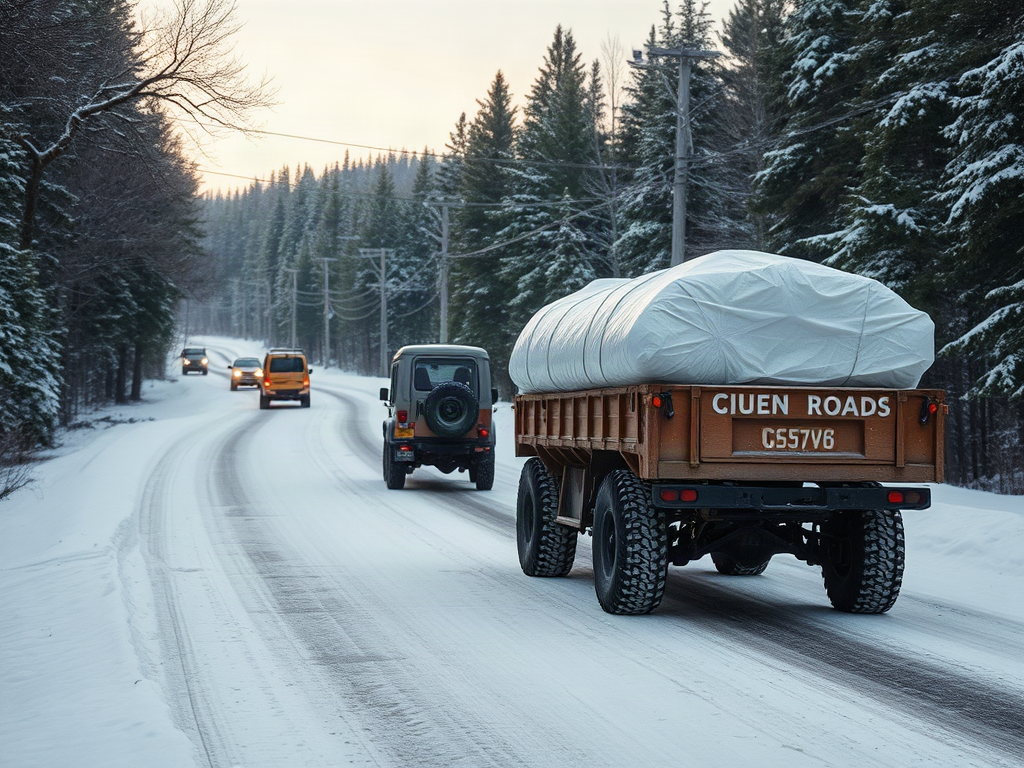
Winter road access for remote homestead resupply depends on matching the vehicle, cargo, and departure date to snow depth, thaw conditions, bridge limits, and the road’s weakest section. Stock durable food, fuel, animal feed, and critical repair supplies before forecast storms or freeze-thaw cycles make the route unreliable. Use a current road inspection, tire chains or equivalent traction equipment, recovery gear, and a turnaround point rather than relying on momentum. A smaller staged load may be safer than one overloaded trip, while a trailer can become a liability on narrow, icy grades. Treat changing weather, blocked drainage, soft shoulders, and limited communications as reasons to delay or divide the trip.
What Makes a Winter Homestead Road Usable
A passable winter road is not defined by snow depth alone. Usability depends on the road surface, drainage, slope, exposure, traffic, and the condition of the final approach to the homestead. A compacted snow road may carry a loaded vehicle well, while a shallow layer over wet clay can become impassable after a warm afternoon. Ice under loose snow creates a different hazard from deep powder, and a shaded bend may remain frozen after the open section has softened.
Remote access often fails at transition points rather than on the main straightaway. A culvert crossing may develop a weak shoulder, a gate area may collect windblown snow, or a short uphill pitch may become polished ice from repeated braking and acceleration. The last few hundred yards deserve as much attention as the public road. If a delivery vehicle can reach the property entrance but cannot safely cross the private lane, the resupply plan has not succeeded.
Inspect the route using specific observations rather than a vague judgment that conditions “look fine.” Note ruts, standing water, snow berms, exposed rocks, fallen branches, narrow passing areas, bridge surfaces, and places where a vehicle cannot turn around. A route that works for an unloaded pickup may fail with several hundred pounds of feed or heating fuel because added weight changes braking, steering, and clearance.
Compare the cost of an early trip with the cost of a late emergency trip. An early run may require storing supplies in sealed bins, protecting fuel from contamination, and accepting some unused capacity. Waiting may reduce storage time but expose the driver to darkness, worsening weather, or a road that cannot support a recovery vehicle. A useful winter access assessment records the route’s weakest feature and the weather condition most likely to make it fail.
Matching Vehicles, Loads, and Traction to the Route
Vehicle choice should follow the route’s constraints, not the assumption that four-wheel drive solves every winter problem. Four-wheel drive can help a vehicle maintain forward motion, but it does not shorten stopping distance on ice or compensate for poor tires, excessive speed, or an overloaded rear axle. Ground clearance, tire condition, braking performance, turning space, and recovery points may matter more than drivetrain branding.
Use tires suited to the actual surface and carry traction equipment that can be installed before the vehicle is stuck. Chains may be useful on packed snow or icy grades, but they require correct fit, clearance, and practice. A shovel, tow strap rated for the vehicle, traction boards, gloves, lighting, and a way to communicate are more useful when accessible from the cab rather than buried beneath feed bags. Do not treat a winch as permission to travel alone on a route where a failed extraction could leave the vehicle in a dangerous position.
Load placement affects control. Dense items such as canned food, batteries, tools, and fuel containers should be secured low and close to the vehicle’s center, while loose bags and containers need protection from shifting. Confirm payload limits before combining firewood, animal feed, water, and household goods. A trailer can increase capacity, but it also lengthens the stopping distance, widens the turning path, and may slide sideways on a descent. On a steep, narrow lane, two smaller trips may be safer than one large trailer movement.
Consider different transport options for different sections. A highway-capable truck may be appropriate for the public road, while a compact utility vehicle, sled, handcart, or packed storage point may handle the final section better if local conditions permit. Each alternative has limitations: a sled needs a stable surface, a handcart struggles in ruts, and a small vehicle may lack braking capacity for a heavy load. The right arrangement reduces exposure at the weakest point rather than maximizing cargo in a single run.
Before departure, check tire pressure, coolant protection, battery condition, lights, windshield visibility, spare tire access, and fuel reserve. Secure every item against movement. A load that shifts during a downhill turn can destabilize the vehicle even when the road itself is sound.
Building a Resupply Schedule Before Access Fails
A winter resupply schedule should be based on consumption rates, storage life, and the time needed to recover from a missed trip. Separate supplies into three groups: daily necessities, items that protect the operation, and items that can wait. Food, drinking water treatment materials, heating fuel, livestock feed, medications, batteries, and critical repair parts usually deserve earlier attention than bulk building materials or discretionary purchases.
Calculate usage from actual records instead of relying on memory. A household may underestimate feed consumption during cold weather because animals expend more energy, or overlook the extra fuel used for warming engines, pumping water, and clearing snow. Record the amount on hand, average weekly use, minimum reserve, and the lead time required for another trip. The reserve is not a promise that access will be impossible for a fixed number of days; it is a buffer against uncertain weather and vehicle problems.
Storage location changes the value of a supply. Fuel stored far from the generator may be technically available but difficult to move during a storm. Feed stacked where drifting snow blocks the door is not an effective reserve. Keep essential goods in dry, rodent-resistant containers, label older stock for earlier use, and leave enough access space to inspect containers without unloading an entire room. Rotate batteries, lubricants, animal feed, and other items whose condition can decline in cold or damp storage.
A practical departure trigger might combine a weather forecast, a road observation, and inventory status. For example, if a thaw is expected after a period of packed snow, the road may be easier before the thaw than during it, when the surface loses strength and deep ruts form. If heavy snow is forecast, departing early may be sensible only if the route is already inspected and the return window is adequate. Forecasts are decision inputs, not guarantees.
Remote households should avoid making one supplier, one vehicle, or one access road the entire system. A modest local cache, a second source for animal feed, or an agreed delivery point can reduce dependence on a single difficult trip. The tradeoff is added handling and storage cost, but redundancy may be cheaper than an urgent delivery after the road has deteriorated. The resupply record should include what was used, what failed, and which route section caused delay.
Inspection, Recovery, and Safe Turnaround Decisions
Route inspection should happen before the vehicle is committed to the most isolated section. Walk or slowly drive the approach when visibility is good, checking the road edge, culverts, gates, overhead branches, and turning areas. Look for water beneath snow, tire tracks that end abruptly, fresh slumping at a ditch, and ice polished by repeated traffic. A narrow road with no safe turnaround deserves a lower load and a stricter departure threshold than a route with frequent pullouts.
Recovery planning is part of access planning, not an afterthought. Tell a reliable person the route, destination, expected return, and the point at which contact should be attempted. Carry a charged phone or radio suited to the local coverage pattern, but do not assume communication will work in a hollow or behind a ridge. Dress for an unplanned stop outside the vehicle and keep emergency heat, water, food, and lighting available in the passenger compartment.
Choose a turnaround point before departure. If the road becomes narrower, the surface softer, or the slope more slippery than expected, retreat while the vehicle still has room to maneuver. Continuing because the destination is close is a common failure mode; a vehicle stuck fifty yards from the homestead can be harder to recover than one stopped at a wider lower point. Never use repeated wheel spin as a test of progress. It can excavate the surface, overheat components, and turn a marginal track into a trench.
Arrival does not end the risk. Unload on stable ground, keep people clear of a vehicle under tension, and avoid parking where melting snow can freeze around tires or block the next departure. Inspect the vehicle afterward for packed snow around brakes, damaged lines, loose chains, and underbody impacts. A driver who returns safely but leaves the vehicle unable to make the next trip has only postponed the problem.
Different conditions call for different thresholds. A trained driver with a properly equipped vehicle may accept a compacted route that would be unsuitable for a lightly loaded passenger car. Neither should assume that previous success predicts the next trip: one warm afternoon, a new rut, or a fallen tree can change the route’s risk profile quickly.
A Practical Winter Resupply Sequence
The most reliable sequence moves from inventory to route evidence, then to vehicle preparation and load decisions. It prevents the common mistake of buying supplies first and discovering afterward that the planned transport cannot safely carry them to the property.
- Review consumption and reserves. Identify the items that would interrupt heating, water, animal care, food preparation, or essential repairs if unavailable.
- Check the complete route. Confirm the public road, private lane, gate, bridge, drainage crossings, and final unloading area rather than checking only the main highway.
- Set a weather-based departure window. Consider snow, rain, thawing, windblown drifts, darkness, and the likely condition on the return journey.
- Match cargo to payload and traction. Reduce the load, split the trip, or change transport if the vehicle would be near its limit or the trailer would compromise control.
- Prepare recovery and communication gear. Place equipment where it can be reached, notify a contact, and establish a clear stop-and-return rule.
- Reassess at the final decision point. If road conditions differ from the inspection, delay, unload at a safe staging area, or turn around before entering the most difficult section.
Signs the system is working include predictable inventory records, early detection of road changes, fewer overloaded trips, and supplies stored where they can actually be reached. Signs it is failing include repeated last-minute runs, unexplained shortages, reliance on tire tracks from unknown vehicles, or a growing habit of driving farther after the route has already become unsafe.
Keep the sequence flexible. A homestead with livestock may prioritize feed and water equipment, while a property dependent on wood heat may prioritize fuel handling and access for a loaded trailer. The winter access decision should reflect the consequence of delay, not merely the convenience of completing one trip.
Frequently Asked Questions
How much reserve should a remote homestead keep for winter?
Set the reserve from recorded consumption and the longest realistic delay in reaching the property. Separate essential heating, water, food, feed, medication, and repair supplies from items that can wait.
Is four-wheel drive enough for a snowy homestead road?
No. Four-wheel drive may improve forward traction, but tires, braking, road surface, payload, clearance, and driver judgment still determine whether the trip is safe.
Should supplies be delivered before a major snowstorm?
Often, an earlier trip is preferable when the route has been inspected and the return window is clear. Avoid rushing solely because of a forecast if the road is already deteriorating or the vehicle is unsuitable.
When should a driver turn around?
Turn around before entering a section with no recovery space when visibility, traction, road strength, or vehicle control is worse than expected. A short distance to the homestead does not reduce the recovery risk.
Are trailers useful for winter homestead resupply?
Trailers can increase capacity on wide, stable roads, but they add length, braking demand, and sliding risk. A smaller load or separate trip may be safer on narrow, steep, icy, or poorly drained lanes.
Further Reading
Authoritative Sources
- Winter Weather Safety
ready.govProvides official preparedness advice for travel, communications, heating, and supply interruptions during winter weather
- Winter Weather Safety
weather.govExplains winter hazards, forecast information, and travel risks that can affect remote road access
- Winter Driving Tips
nhtsa.govOffers government guidance on vehicle preparation, traction, visibility, and safer winter travel decisions
Conclusion
Reliable winter access comes from reducing uncertainty before the vehicle reaches the difficult part of the route. Track actual consumption, protect essential reserves, inspect the entire approach, and treat the weakest crossing, slope, or turnaround as the controlling feature. Match the cargo to the vehicle rather than forcing one trip to carry everything, and keep recovery equipment, communication gear, and cold-weather clothing within reach. Weather changes can make yesterday’s successful drive irrelevant, particularly during thawing, refreezing, heavy drifting, or poor visibility. Before the next resupply run, write down the departure threshold, the safe turnaround point, and the minimum supplies that must be replenished. That small record converts winter access from a last-minute gamble into a repeatable operating decision.