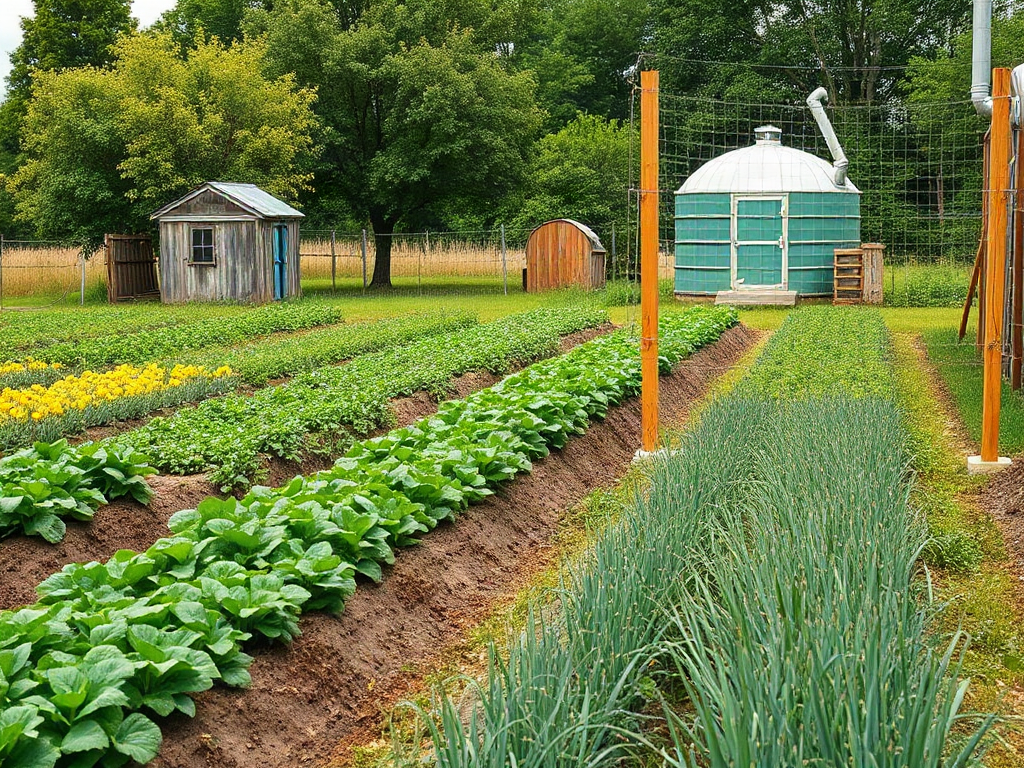
A self-sufficient farm should match food production and utility systems to the land’s usable soil, dependable water supply, household demand, and available labor before acreage is assigned. Plan staple foods, fresh produce, livestock, energy, sanitation, and storage as connected systems rather than separate projects. Size each system for difficult periods such as winter, drought, equipment failure, and seasonal harvest surpluses, while retaining backups for drinking water and critical power. The strongest plan reduces recurring outside inputs without assuming total independence, using measured consumption, conservative yields, repairable infrastructure, and staged investments to keep the farm workable.
Define the Farm’s Actual Supply Targets
Self-sufficiency becomes measurable only after the household defines what the farm must supply. A property intended to provide summer vegetables has a different land, labor, and storage burden from one expected to furnish staple calories, animal products, heat, electricity, and year-round water. Begin with household consumption records rather than an acreage-based vision. Utility bills, grocery receipts, preserved-food inventories, fuel purchases, and livestock expenses reveal the demand that the farm must eventually replace.
Separate needs into three levels: critical, routine, and optional. Drinking water, sanitation, safe food storage, shelter heating in a cold climate, and power for medical or water-pumping equipment belong in the critical level. Routine needs may include cooking energy, vegetables, eggs, laundry water, workshop electricity, and livestock feed. Optional production includes foods the household rarely eats, energy-intensive amenities, or enterprises intended primarily for sale. This distinction prevents attractive projects from consuming money while essential systems remain fragile.
Food targets should be expressed in quantities and seasons. Instead of planning to “grow most vegetables,” estimate how many weekly servings the household uses, which vegetables preserve well, and how much cold or dry storage is available. Potatoes, dry beans, winter squash, onions, and grains contribute more stored energy than salad greens, but they occupy ground for longer periods and may require specialized harvesting or processing. Eggs and milk add valuable foods, yet animals introduce daily labor, housing, winter feed, veterinary needs, and manure management.
A practical baseline records at least twelve months of demand when possible. Shorter records can miss winter heating, irrigation peaks, holiday food use, or seasonal livestock expenses. Convert the findings into annual targets with monthly peaks: gallons of potable water per day, kilowatt-hours by month, pounds or jars of stored food, and weeks of animal feed. Allow for spoilage, seed retention, maintenance downtime, and poor harvests rather than treating the best season as normal.
A common failure is treating self-sufficiency as a percentage without defining its boundary. A farm may produce nearly all its vegetables while buying compost, seed, fuel, feed, replacement parts, and food-preservation supplies. Those purchases are not necessarily failures; they simply belong in the dependency ledger. The first working document for Self-sufficient farm planning for food and utility needs should therefore show both household outputs and the outside inputs required to produce them.
Match Food Production to Land, Water, and Labor
Productive acres matter less than acres suited to a specific use. Map soil depth, drainage, slope, sun exposure, prevailing wind, frost pockets, access routes, and the distance from water. A sunny field with poor access may be inconvenient for daily harvesting, while a fertile low area may remain too wet for early planting. Place frequently tended vegetables, herbs, propagation space, and small livestock close to the house; reserve distant ground for orchards, grazing, woodlots, or field crops that require less frequent attention.
Soil testing and direct observation should precede permanent layout decisions. Laboratory results can identify pH and nutrient conditions, while a shovel test shows compaction, rooting depth, texture changes, and standing water. Observe the site through wet and dry periods before installing an orchard or extensive fencing. Trees planted in a frost pocket or waterlogged subsoil can lose years of growth, and moving a fence after animal pressure damages saturated ground is far more expensive than revising a paper plan.
Water availability sets a hard ceiling on production. A garden, orchard, and flock may appear reasonable separately but create an unmanageable combined demand during a dry month. Estimate peak irrigation and animal use, then compare it with well recovery, spring flow, pond capacity, roof catchment, and any legal or practical limits on withdrawal. Rainwater can reduce pressure on a well, but seasonal rainfall, roof area, tank volume, water quality, freezing, and pump requirements determine what it can actually supply.
Labor is another finite farm resource. A household that works away from the property may succeed with drip-irrigated perennials, storage crops, laying hens, and a modest garden, yet struggle with dairy animals, hand-watered beds, multiple annual plantings, and intensive food processing. Mechanization can reduce physical effort, but it adds purchase cost, fuel, storage, repairs, and dependence on parts. The better choice is the system that remains manageable during illness, travel, heat, and harvest overlap—not the one with the highest theoretical output.
Use a compact siting checklist before committing land:
- Production fit: Does the crop or animal suit the soil, climate, and available water?
- Daily access: Can feeding, inspection, harvesting, and repairs be done in poor weather?
- Processing path: Is there space to wash, cool, dry, butcher, mill, or preserve the output?
- Input burden: Will fertility, seed, bedding, feed, or fuel still need to be purchased?
- Failure response: What happens if irrigation, fencing, refrigeration, or labor is unavailable?
Signs of a sound layout include short daily routes, stable soil cover, predictable irrigation pressure, and harvest quantities that can be processed promptly. Warning signs include unused surpluses, recurring erosion, feed stored far from animals, hoses crossing vehicle lanes, and crops wilting while a nominal water source remains inaccessible.
Design Reliable Water, Energy, and Sanitation Systems
Utility planning should begin with demand reduction and critical loads, not generation equipment. Insulation, shade, efficient pumps, gravity distribution, low-flow fixtures, and sensible appliance choices reduce the size and cost of every later system. List electrical loads by watts, hours of use, starting surge, and season. A refrigerator, freezer, well pump, pressure system, ventilation fan, and communications equipment deserve priority over workshop tools or whole-house convenience loads during an outage.
Water planning needs separate paths for potable, household non-potable, irrigation, livestock, and emergency use. Water suitable for trees is not automatically safe for drinking or food washing. Wells, springs, ponds, cisterns, and roof catchment each have different contamination risks and treatment needs. Potable systems may require testing and treatment appropriate to local conditions, while stored emergency water needs protected containers and a rotation practice. Local health departments, extension offices, and qualified water professionals can help interpret test results and applicable requirements.
Gravity-fed storage offers operational simplicity where elevation permits it, but a tank must still be sized, protected from freezing or heat, screened from pests, and installed on a suitable base. Pumped systems deliver greater pressure but depend on electricity and mechanical components. A useful compromise is a primary pump with enough elevated or pressure storage to cover essential use during a short interruption. A second pump is not meaningful redundancy if it relies on the same failed controller, power source, or inaccessible intake.
Energy choices should follow the resource available on the site. Solar electricity is modular and has no fuel requirement during operation, but output changes with weather and season; batteries add limited-duration storage rather than unlimited supply. A generator can operate large loads and recharge batteries, but it introduces fuel storage, exhaust, noise, and maintenance. Wood heat can use land-based fuel where forests are managed sustainably, though cutting, seasoning, moving, and safely burning wood require substantial work. Combining a reduced critical-load circuit, modest battery capacity, and a properly installed backup source is often more resilient than attempting to power every appliance indefinitely.
Sanitation must be designed alongside water because wastewater volume, soil suitability, setbacks, and maintenance affect the entire site. Septic systems require appropriate siting and care. Composting or alternative toilets may reduce water use in some settings, but they do not remove the need to manage handwashing, kitchen wastewater, bathing water, local rules, and pathogen risks. Never route untreated household wastewater onto food crops or assume that a rural location removes public-health obligations.
The utility portion of a Self-sufficient farm planning for food and utility needs plan is working when critical loads can be isolated, water quality is known, storage levels are visible, and another household member can operate shutdowns and backups. Frequent battery depletion, falling well pressure, overheated pump controls, contaminated tanks, or a generator that cannot start the pump indicate that calculated capacity and actual operation do not match.
Build Storage, Redundancy, and a Phased Budget
Production without preservation merely changes the timing of waste. Storage capacity should be planned before expanding gardens, orchards, livestock, or field crops. Different foods require different conditions: dry beans and grain need dryness and pest exclusion; potatoes favor cool, dark conditions; onions need ventilation; canned food needs protected shelving; frozen meat depends on continuous power. A single warm basement or crowded freezer cannot reliably serve every product.
Match preservation methods to both the food and the utility system. Pressure canning, water-bath canning, dehydration, fermentation, freezing, curing, and cool storage have distinct safety requirements and energy demands. Use tested preservation procedures from reputable extension or government sources rather than improvising processing times. Freezing is convenient but concentrates risk in electricity and equipment. Shelf-stable preservation reduces that exposure, although it requires containers, heat, labor, and secure storage. A mixed approach prevents one equipment failure from threatening the entire harvest.
Redundancy should remove single points of failure instead of duplicating every component. Two freezers on the same overloaded circuit are not independent. Two wells using the same power system may both stop during an outage. More useful layers include stored potable water plus a serviceable primary source, gravity irrigation plus a pump for pressure, shelf-stable food plus frozen food, and manual tools that can complete essential work when powered equipment is unavailable.
Build the farm in phases tied to observed performance:
- Measure and stabilize: Document demand, test soil and water, repair drainage, reduce energy waste, and establish safe storage.
- Prove a small production system: Operate a manageable garden, limited livestock enterprise, or orchard block through a full season.
- Add processing and reserves: Expand pantry, cold storage, feed protection, water capacity, and preservation equipment before increasing output.
- Strengthen critical utilities: Install backup pumping, critical-load power, spare wear parts, and clear operating procedures.
- Scale only from records: Increase acreage or animals after yields, labor hours, losses, and costs show that the existing system is stable.
Budgeting should include installation, recurring inputs, maintenance, replacement, and the cost of failures. A greenhouse needs more than a frame; ventilation, irrigation, anchoring, repairs, and seasonal temperature control may determine whether it is useful. Livestock fencing needs gates, energizers or posts, vegetation control, and repair materials. Solar equipment eventually requires component service or replacement. Set aside money for maintenance before directing every available dollar toward expansion.
A common mistake is pursuing the highest nominal return or production volume first. Infrastructure that prevents loss often has greater practical value. A protected feed room, reliable fence, drainage improvement, cool pantry, or water-level alarm may contribute more to yearly resilience than another cultivated plot. Review Self-sufficient farm planning for food and utility needs quarterly against actual records. Rising spoilage, deferred maintenance, exhausted labor, repeated emergency purchases, or declining soil cover are signals to simplify rather than expand.
Frequently Asked Questions
How much land does a self-sufficient farm need?
No universal acreage works for every household. Climate, soil, water, diet, livestock, purchased inputs, and growing-season length matter more than a simple land figure. Estimate the space for chosen foods and utilities, then add access, rotation, storage, habitat, and poor-year capacity.
Should food production or off-grid power come first?
Begin by measuring both food and energy demand, then correct immediate risks such as unsafe water, failing sanitation, or unreliable refrigeration. Small food production and energy-efficiency work can proceed together, while expensive generation equipment should follow a verified load assessment.
Can rainwater supply all household and farm needs?
It may cover part or all of demand on suitable sites, but roof area, rainfall distribution, tank capacity, drought length, treatment, freezing, and local rules determine feasibility. Potable use requires appropriate collection safeguards, testing, and treatment rather than assuming clear water is safe.
What farm system should be built first?
Start with site observation, soil and water assessment, demand records, drainage, and secure storage. Then prove one small production system that fits household labor. Early results provide better sizing information for irrigation, preservation space, fencing, and utility backups.
Does a self-sufficient farm need to eliminate all outside purchases?
No. Strategic purchases of seed, tools, medicine, fuel, minerals, parts, or specialized services may be safer and more efficient than producing everything on-site. Track those dependencies and keep reserves or alternatives for inputs whose interruption would stop critical operations.
Further Reading
Authoritative Sources
- USDA NRCS Web Soil Survey
websoilsurvey.nrcs.usda.govProvides mapped soil information useful for comparing drainage, limitations, and potential land uses before laying out farm systems
- NREL PVWatts Calculator
pvwatts.nrel.govEstimates photovoltaic energy production using location and system details, helping readers compare expected output with farm electrical demand
- National Center for Home Food Preservation
nchfp.uga.eduOffers research-based directions for canning, freezing, drying, fermenting, and storing household food safely
- U.S. EPA Septic Systems
epa.govExplains septic-system operation, maintenance, and household practices relevant to rural wastewater planning
Conclusion
A workable farm plan grows from measured household demand, honest site limits, and systems that remain manageable during difficult seasons. Record food, water, power, fuel, and labor use before sizing production. Place intensive activities near dependable access, reserve land according to soil and water capability, and provide processing space before increasing harvests or livestock numbers. Critical utilities deserve independent safeguards: tested drinking water, protected reserves, isolatable electrical loads, safe sanitation, and backup methods that do not share the same point of failure. Build one phase through a full operating cycle, compare predicted and actual performance, and correct losses before scaling. The next step is a property map and dependency ledger showing sources, peak demands, storage, outside inputs, maintenance intervals, and the consequence of each system failing.