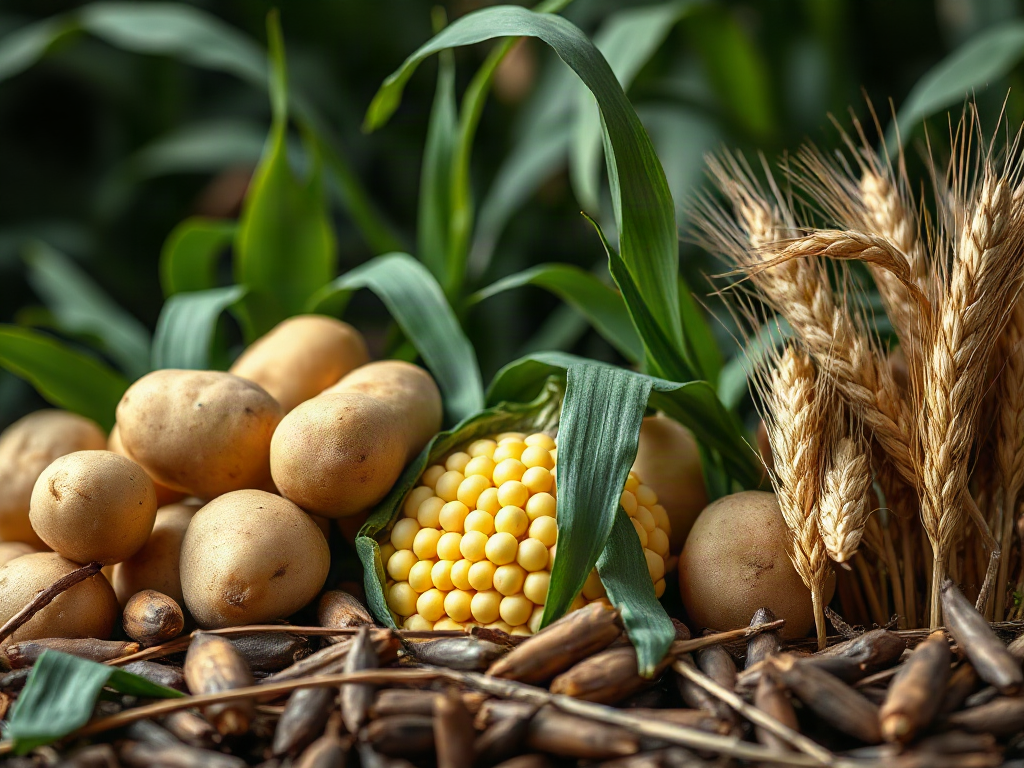
Calorie production comparison between staple crops favors potatoes and cassava for high food energy per unit of land under suitable conditions, while maize, rice, and wheat offer stronger storage, processing, or dietary advantages. The result changes with yield, edible portion, moisture content, growing season, soil, water, labor, and post-harvest losses. Potatoes can produce substantial calories quickly but are perishable and vulnerable to disease; cassava tolerates poorer conditions yet requires careful processing in some varieties. Maize and wheat store well as dry grain, while rice depends heavily on water and milling. Compare crops on harvested edible calories, not fresh weight alone, then balance calorie density with reliability, nutrition, labor, and storage.
How Calorie Comparisons Should Be Measured
A useful comparison begins by separating calories per kilogram from calories per area. Dry grain appears highly calorie-dense because much of its water has been removed, whereas a freshly harvested potato contains substantial moisture. Comparing one kilogram of fresh potatoes with one kilogram of dry maize therefore gives a misleading impression. Land productivity, edible yield, cooking losses, milling losses, and storage losses all affect how much food energy reaches a household.
For practical planning, estimate calories in three stages: harvested mass, edible portion, and usable food after processing. A crop with a large field yield may lose its advantage if peeling, milling, shelling, or spoilage removes a significant share. Rice also needs a distinction between paddy and milled rice, while wheat may be measured as grain before flour milling. Cassava needs attention to peeling, drying, and any processing required by the variety.
Fresh-weight comparisons are still useful when deciding what can be eaten soon after harvest. Dry-weight comparisons are more informative for stored reserves. An approximate calculation can use the following structure:
- Usable calories: harvested weight × edible fraction × calories per unit weight.
- Land output: usable calories divided by cultivated area.
- Reserve value: usable calories remaining after drying, milling, storage, and preparation.
Weak comparisons often treat published yield figures as guaranteed results. Actual output depends on cultivar, planting date, fertility, weeds, pests, rainfall, irrigation, and harvest timing. A crop that ranks first in a favorable trial may be a poor choice where its disease pressure, water demand, or storage requirements exceed local capacity. The calorie production comparison between staple crops should therefore be treated as a decision tool rather than a universal ranking.
Potatoes and Cassava: High Energy From Fresh Roots
Potatoes and cassava can produce large amounts of food energy from a relatively small planting area, but their advantages come with different operational costs. Potatoes generally provide a quicker harvest and can fit into shorter growing windows. Cassava develops a large underground root system and can remain in the ground as a living reserve, making harvest timing more flexible in some climates.
Potatoes contain more water than dry grains, so their calories per kilogram are lower on a fresh basis. Their practical strength is often the combination of edible yield, short maturity for early varieties, and multiple cooking uses. A household may boil, roast, or preserve them, although storage requires protection from light, freezing, rot, and sprouting. Poor ventilation or damaged tubers can turn a strong harvest into a rapidly shrinking food reserve.
Cassava is valuable where heat, irregular rainfall, or less fertile soil limits other staples. Its roots are bulky and contain considerable moisture, so moving and storing them is more difficult than storing dry grain. Some cassava varieties require grating, soaking, fermenting, drying, or thorough cooking to reduce naturally occurring compounds that can be harmful when preparation is inadequate. Variety selection and established local processing practice matter more than a simple yield ranking.
Consider two contrasting situations. A garden with reliable water, good soil, and a short season may favor potatoes because fresh food is available sooner. A larger planting in a warm region with limited storage infrastructure may favor cassava because roots can remain underground until needed, although harvesting and processing require labor. Neither crop automatically supplies a complete diet; both are mainly energy sources and should be paired with legumes, vegetables, animal foods, or other nutrient-dense choices where available.
Common mistakes include counting the entire harvested root as ready-to-eat food and ignoring labor after harvest. Before choosing, check expected edible yield, days to harvest, disease exposure, processing equipment, and whether the crop can be replanted from locally available material. The staple-crop calorie comparison becomes more realistic when these constraints are recorded beside the yield estimate.
Maize, Rice, and Wheat: Grain Calories and Storage
Maize, rice, and wheat usually compete strongly when the goal is a durable calorie reserve. Once properly dried, grain is compact, stackable, and less vulnerable to the rapid spoilage that affects fresh roots. Grain crops do not always deliver the highest fresh harvest weight, but their low moisture and storage potential can produce more dependable usable calories over several months.
Maize has broad adaptation and can be eaten fresh, dried, ground, or processed into meal. Its final calorie yield depends on whether the calculation includes cob weight, husks, kernel removal, and milling. Dried maize needs protection from insects, rodents, and moisture. A crop that appears productive in the field may provide less food if drying is incomplete or if stored grain develops mold.
Rice is highly productive in environments suited to it, but water management is a central constraint. Paddy yield is not equivalent to the amount of milled rice in a cooking pot because husk removal and milling reduce the mass. Excessive milling can also remove nutrient-rich outer layers. Rice may be an efficient calorie crop for a suitable lowland system, yet a poor fit where irrigation is unreliable or where standing water is difficult to manage.
Wheat offers strong storage and processing flexibility, especially where milling and baking facilities already exist. Its performance depends on temperature, rainfall pattern, soil fertility, and disease pressure. Grain can be stored for long periods when sufficiently dry and protected, but flour generally has a shorter practical storage life than intact grain because milling exposes more surface area to oxidation and pests.
A useful comparison separates field performance from household performance. Maize may be easier to grow than rice in a rain-fed plot; rice may outperform both under suitable water control; wheat may be preferable where winter growth and milling are established. The wrong assumption is that the crop with the highest reported yield supplies the most secure reserve. Check drying conditions, storage containers, milling access, seed availability, and the labor required to turn grain into edible meals.
Choosing a Staple for Land, Labor, and Storage Limits
The best calorie crop is the one that produces usable food reliably within the available production system. Land area matters, but so do water access, labor peaks, tools, planting material, pest exposure, and the time between harvests. A crop can rank well by theoretical calories and still fail as a household staple if it requires a processing step that cannot be completed safely or consistently.
Start by identifying the limiting resource. On scarce land with dependable moisture, a high-yielding root crop may make sense, provided the household can use or preserve the harvest. Where storage is the priority, dry maize, rice, or wheat may be more suitable. Where labor is limited during harvest, a crop with a flexible harvest window may have an advantage over one that must be lifted and processed immediately.
Use a simple comparison sheet rather than a single ranking. Record expected edible calories, growing duration, water requirement, planting material, peak labor, processing needs, storage life, and likely failure mode. Then assign each crop to a role: rapid food, long-term reserve, risk-spreading crop, or supplemental staple. Combining two or more crops can reduce exposure to one pest, drought period, or harvest bottleneck, even if a single crop has a higher theoretical calorie output.
- Estimate local yield: use several seasons of household or local records rather than an idealized catalog figure.
- Subtract handling losses: include peeling, milling, drying, pests, spoilage, and rejected food.
- Match timing to labor: compare planting and harvest workloads with available workers and tools.
- Test storage: preserve a small portion first and inspect it through the intended storage period.
- Balance the diet: pair energy staples with protein, fats, minerals, and vitamins from other foods.
Signs that an approach is working include predictable harvest dates, low storage loss, manageable processing, and meals that do not depend on one vulnerable crop. Warning signs include repeated late harvests, wet grain, widespread tuber rot, unprocessed cassava accumulating, or a calorie plan that leaves no room for nutrient-rich foods. A diversified system may produce fewer headline calories in one season while delivering more dependable food across difficult seasons.
Readers comparing options can also review calorie production by staple crop alongside local seed access and preservation capacity. That combination is more useful than importing a ranking from a different climate or farming system.
Frequently Asked Questions
Which staple crop usually produces the most calories per area?
There is no universal winner. Potatoes, cassava, maize, rice, or another crop may lead depending on climate, yield, moisture, harvest losses, and local growing conditions.
Are potatoes more calorie-dense than rice?
Dry rice is more calorie-dense by weight because potatoes contain much more water. Potatoes may still produce strong calories per area when yields and growing conditions are favorable.
Why should paddy rice and milled rice be separated?
Paddy includes the inedible husk and must be milled before cooking. Comparing it directly with ready-to-cook rice overstates the calories available to the household.
Is cassava a good long-term food reserve?
Cassava can provide a flexible harvest in suitable climates, but fresh roots are bulky and perishable. Drying or other established processing is needed for a more durable reserve, and preparation must suit the variety.
What should be included in a crop calorie calculation?
Include harvested yield, edible fraction, moisture basis, processing losses, storage losses, growing duration, and the labor and water needed to produce and preserve the food.
Further Reading
Authoritative Sources
- Academy of Nutrition and Dietetics
eatright.orgProfessional nutrition guidance, healthy eating resources, and practical dietitian-reviewed advice.
- U.S. Department of Agriculture
usda.govOfficial food, nutrition, agriculture, and consumer guidance from the USDA.
- NIH Office of Dietary Supplements
ods.od.nih.govResearch-based fact sheets on nutrients, supplements, dietary intake, and safety considerations.
- International Society of Sports Nutrition
sportsnutritionsociety.orgEvidence-informed sports nutrition resources and position stands for active people and athletes.
Conclusion
Calorie output is only useful when it describes food that can actually be harvested, processed, stored, and eaten. Roots such as potatoes and cassava can provide substantial energy, while maize, rice, and wheat are often stronger candidates for dry reserves. Compare them on the same moisture basis, subtract realistic handling losses, and test assumptions against local soil, weather, labor, and storage conditions. A practical plan may combine a quick or flexible root crop with a durable grain and separate calorie production from dietary completeness. Record results from each season, especially failed plantings and storage losses, then adjust the crop mix rather than relying on a fixed global ranking.