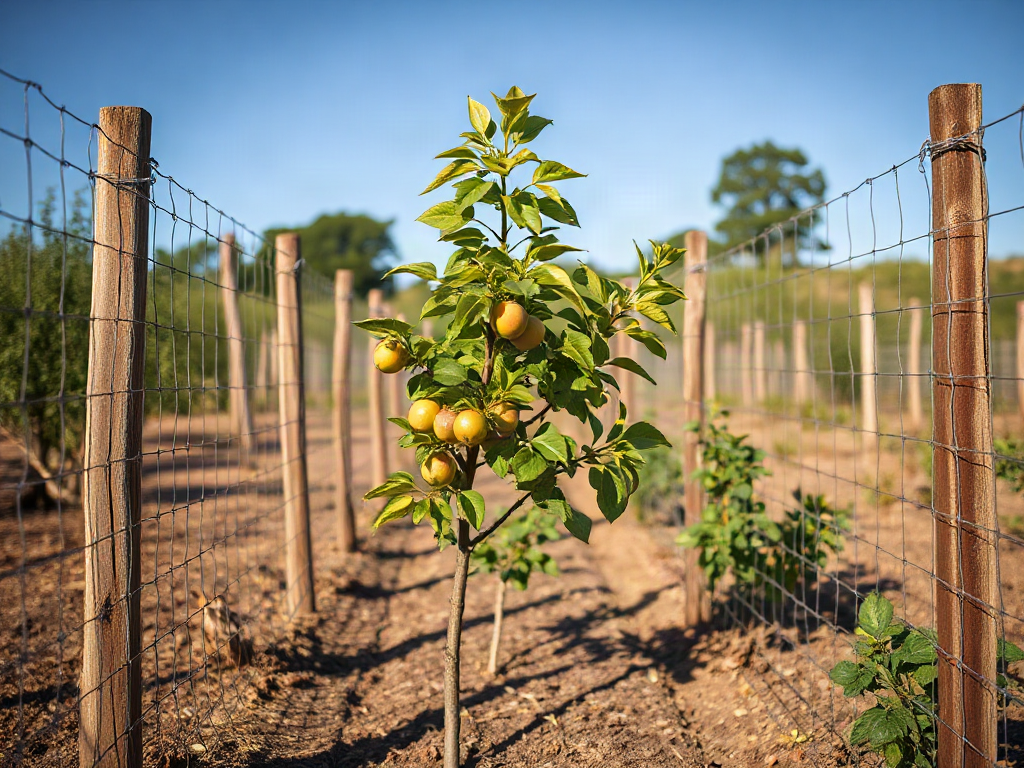
Protect young fruit trees from browsing animals by placing a rigid, ventilated guard around each trunk and using fencing tall or wide enough to stop deer, rabbits, or livestock from reaching shoots and bark. Guards should extend above expected snow depth, leave room for trunk growth, and be checked for rubbing, trapped moisture, and rodents. Where animal pressure is high, perimeter or individual-tree fencing is more dependable than scent or taste repellents. Repellents can reinforce a physical barrier, but rain, new growth, and animal hunger reduce their reliability. Inspect protection through winter and early spring, when bark stripping and loss of buds can permanently weaken tree structure.
Identify the Animal and the Damage Pattern
Fresh damage reveals which defense is likely to work. Deer commonly remove buds and young shoots with ragged tears because they lack upper incisors. Rabbits and hares leave cleaner, angled cuts on small stems and may strip bark near ground level. Voles work lower and often gnaw beneath grass, mulch, snow, or loose shelters. Livestock can browse foliage, rub against stakes, and push through lightweight barriers, creating both feeding and structural damage.
Height narrows the possibilities. Damage well above rabbit reach, especially on branch ends, points toward deer. Bark injury hidden at the soil line or beneath mulch is more consistent with small rodents. Snow changes the effective browsing height: a guard that appears tall in autumn may protect only its lower half after snow accumulates. Inspect tracks, droppings, hair caught on fencing, and the shape of tooth marks rather than assuming every missing twig came from the same visitor.
The part consumed matters as much as the amount. Loss of a few side shoots may slow growth, but repeated removal of the central leader can produce competing tops and a poorly shaped crown. A complete ring of missing bark is more urgent because it interrupts the living tissue that moves sugars from leaves toward the roots. Partial bark wounds may close gradually if their edges remain intact; improvised wound coatings generally do not replace missing vascular tissue.
Animal pressure should determine how much protection to build. A single rabbit sighting in an open yard does not justify the same installation as a rural orchard crossed nightly by deer. Look for repeated tracks, nearby cover, winter food scarcity, and prior damage to ornamentals. Young apple trees beside woodland, for example, may need both trunk protection and a wide deer barrier, while a fenced garden with occasional rabbit activity may only require sturdy mesh cylinders.
A common mistake is treating visible branch loss while leaving the trunk accessible. Tender buds attract attention first, but bark becomes especially vulnerable when other food is scarce. Record the highest and lowest damage, identify the likely species, and protect every reachable portion of the tree. That diagnosis turns Protecting young fruit trees from browsing animals from guesswork into a barrier decision based on reach, persistence, and feeding behavior.
Choose a Barrier That Matches the Browsing Pressure
Physical exclusion provides the most dependable defense where animals visit repeatedly. The barrier must account for an animal’s height, ability to squeeze or dig, and willingness to lean against weak material. A decorative ring close to the trunk may stop casual contact yet still allow deer to reach over it and consume every exposed shoot.
For rabbits and hares, small-opening wire mesh formed into a free-standing cylinder is usually more useful than open field fencing. The lower edge needs to meet the soil closely or extend slightly below it where digging occurs. Its top should remain above both normal browsing height and expected snowpack. Leave enough diameter that animals cannot press the mesh against the bark and chew through it. A narrow cylinder may protect the trunk while sacrificing branches that protrude through the openings.
Deer exclusion depends on reach as well as jumping behavior. A sufficiently tall perimeter fence can protect multiple trees, but it costs more and requires gates, corner support, and vegetation control. An individual enclosure can be lower if it is wide enough to keep the deer away from the canopy; a tight cage around a tree merely gives the animal a boundary to reach across. Visible, well-tensioned material is generally preferable to barely visible strands around areas used by people, pets, or wildlife.
Livestock require stronger posts and fencing than wild browsers because cattle, goats, sheep, and equines may lean, scratch, or test a barrier. Place orchard trees outside routine animal access when possible. If trees share a pasture, build a substantial enclosure that protects the rooting area and canopy rather than attaching wire to the tree. Fastening fencing directly to a trunk can girdle it as it expands and creates pressure points when animals push on the fence.
Use a short priority check before buying materials:
- Measure reach: include snow depth and branches extending beyond the barrier.
- Match opening size: small animals can pass through or feed through large mesh.
- Test stability: posts and fasteners should withstand leaning, wind, and wet soil.
- Allow maintenance access: leave a way to weed, prune, water, and inspect bark.
The cheapest barrier is not economical if it needs rebuilding after every storm or animal visit. Conversely, fencing an entire property may be unnecessary for three trees. Match the protected footprint to the number of trees and the observed pressure, then expand only if tracks or new bites appear outside the protected area.
Install Trunk Guards Without Creating New Problems
A trunk guard should block teeth without trapping moisture, constricting growth, or concealing damage. Rigid ventilated mesh often makes inspection easier than an opaque wrap. Whatever material is selected, it should stand away from the bark, resist collapse, and have no sharp edge that rubs the trunk in wind.
Begin at the soil surface and extend the guard above the likely gnawing zone. In snowy climates, use maximum settled snow depth rather than bare-ground height as the reference point. Secure a mesh cylinder to its own stake if needed, keeping ties off the trunk. Check that the bottom does not leave a tunnel where voles can enter. At the same time, avoid packing soil against the bark or burying the root flare merely to close a gap.
Mulch deserves special attention. A broad layer over the root zone can conserve soil moisture and reduce competition, but a mound touching the trunk gives rodents concealed access and keeps bark damp. Pull mulch back from the trunk so the root flare remains visible. Tall grass and weeds inside a guard create similar cover, so remove them by hand rather than striking the protected trunk with a string trimmer.
Plastic spiral guards and solid tubes are convenient, but they need frequent inspection. Tight spirals can constrict a rapidly thickening trunk, while dark or poorly ventilated covers may alter temperature and moisture around bark. Tree shelters designed to influence seedling growth are not automatically wildlife-proof; thin material can be rubbed, crushed, or chewed. Hardware cloth or another durable small-opening mesh may offer better airflow and visibility, although cut edges must be folded or capped safely.
Consider a newly planted pear tree with a narrow plastic sleeve. The sleeve may stop rabbit teeth in its first winter, yet weeds can hide inside it and the top edge may chafe the bark. A wider anchored mesh cylinder permits inspection and growth, but it occupies more space and needs careful handling. Neither choice protects upper buds from deer, so a separate cage or perimeter barrier remains necessary where deer browse.
Installation is not complete until the tree can move slightly without contacting the guard. Examine the setup from several angles, press gently on the mesh, and confirm that branches cannot become pinched. The recurring failure in Protecting young fruit trees from browsing animals is leaving a successful first-year guard in place until it becomes a second-year constriction.
Use Repellents as Reinforcement, Not the Main Defense
Repellents can reduce browsing when pressure is light or provide a second layer outside a barrier, but their effect is variable. Some products rely on an unpleasant taste, while others use odors associated with danger or decay. Both depend on the animal encountering the treated area before it commits to feeding, and neither makes tender fruit-tree growth physically unreachable.
Application timing controls much of their usefulness. Treat susceptible shoots before habitual browsing develops, follow the product label, and restore coverage after weathering or substantial new growth when directed. A spray applied to dormant twigs may no longer cover expanding spring shoots. Rain, irrigation, sunlight, and low temperatures may affect application or persistence, so label restrictions should determine where, when, and how a product is used.
Edible crops require another check: a product labeled for ornamental plants is not automatically suitable for fruit trees, and treatment allowed during dormancy may not be allowed near harvest. Keep spray off fruit unless the label explicitly permits that use. Homemade mixtures create uncertainty about plant injury, food-crop suitability, and effective concentration. Strong-smelling household materials may disappear quickly, wash into soil, or attract an animal rather than deter it.
Repellents are a reasonable option for scattered deer sampling at the edge of a property, especially while a more durable enclosure is being built. They are a weak primary defense for a newly planted tree on an established deer trail or for rabbits feeding under persistent snow cover. Hungry animals may tolerate an unpleasant taste when alternatives are limited, and repeated exposure without a negative consequence may reduce the deterrent value.
Judge performance from the tree, not from how strong the product smells to a person. Intact terminal buds, fewer fresh tracks near treated shoots, and no new tooth marks indicate that the combined approach is working. A missing leader or fresh bark scrape means the protection has failed, even if old damage has not worsened elsewhere. Move promptly to a physical barrier rather than repeatedly changing scents while the tree loses irreplaceable structure.
Repellent cost also accumulates through labor and repeat applications. For a small orchard with frequent pressure, durable fencing may cost more initially but demand less repeated attention. For widely separated trees with occasional visits, targeted treatment plus individual cages may be more practical. The choice should reflect exposure and maintenance capacity, not the promise of a spray-only solution.
Inspect and Adjust Protection Through the Year
Seasonal inspection keeps a protective system from becoming a hidden source of injury. Animals change feeding patterns as natural forage, snow, cover, and human activity change. Trees also expand, branch, and shift in wind, so clearances that worked at planting may be inadequate several months later.
Autumn is the time to close ground-level gaps, clear vegetation from guards, strengthen loose stakes, and measure protection against expected snow. During winter, check after heavy snowfall, drifting, ice, or storms. Packed snow can create a raised platform for rabbits, while fallen branches can flatten fencing. Early spring exposes gnawing that was hidden by snow and brings tender growth that attracts deer. Summer inspections should focus on constriction, abrasion, weeds, and branches growing through mesh.
Look for evidence at three levels. At the ground, inspect for runs, burrows, droppings, displaced mulch, and gnawing near the root flare. Along the trunk, check for moisture, fungal growth, rubbed bark, tight ties, or wire touching expanding wood. At canopy height, find torn buds, clipped shoots, broken leaders, and antler rubbing. Photographing the tree from the same angle each month can distinguish old wounds from fresh damage and reveal whether the cage is becoming too small.
If browsing removes the central leader, do not automatically cut the tree back severely. Wait until active growth shows which buds remain viable, then select a well-positioned shoot to become the new leader and remove or shorten competitors as appropriate for the fruit species and training form. Severe girdling, major trunk splitting, or extensive structural loss may justify advice from a local university extension office or a qualified arborist, particularly when deciding whether replacement is more sensible than rehabilitation.
Protection can usually be reduced once bark is thicker and the canopy rises beyond the relevant browser, but age alone is a poor removal rule. Deer may continue rubbing larger young trunks, and rodents can still work beneath snow. Remove or enlarge individual guards before they restrict growth, while retaining perimeter exclusion if site pressure remains high. A tree is ready for less protection when repeated inspections show no reachable tender bark, no contact with the barrier, and no current signs of animal use nearby.
A practical schedule is to inspect monthly during the growing season and after major winter weather or known animal activity. The interval should shorten where damage has already occurred. For readers refining Protecting young fruit trees from browsing animals, the most useful record is simple: date, damage height, likely animal, barrier condition, and the adjustment made.
Frequently Asked Questions
How tall should a guard be around a young fruit tree?
The guard must exceed the animal's reachable feeding height after accounting for snow. Rabbit guards often need extra winter height, while deer usually require a tall perimeter fence or a wide individual enclosure that keeps them away from branches.
Can chicken wire protect fruit trees from rabbits?
It may deter larger rabbits if openings, seams, and the ground edge prevent access, but small-opening rigid mesh is generally harder to reach through and better at excluding smaller rodents. Keep all wire away from the bark.
Should mulch be placed inside a tree guard?
Mulch may cover the surrounding root zone, but it should not touch the trunk. Leave the root flare visible and remove weeds inside the guard so rodents do not gain concealed access to bark.
Do deer repellents work on young fruit trees?
They may discourage occasional browsing when applied according to a food-crop-appropriate label, but weather, new growth, and hunger reduce reliability. Use fencing where deer repeatedly visit or where losing the leader would seriously affect tree form.
When can tree guards be removed?
Remove or enlarge a guard before it touches the expanding trunk. Wildlife protection can be reduced when vulnerable bark and shoots are no longer reachable and inspections show little local pressure, but deer-rub risk may persist beyond the seedling stage.
Conclusion
Effective protection begins with reading the evidence: damage height, tooth marks, tracks, snow conditions, and the part of the tree being lost. Build exclusion around the animal actually present, giving the trunk and branches enough clearance to grow without touching wire, plastic, or ties. Keep mulch away from bark, close low gaps, and treat repellents as a supplement where browsing is occasional rather than as a substitute for a dependable barrier.
Inspect each installation after storms and through seasonal changes. Fresh bites, a damaged leader, compressed mesh, or hidden gnawing call for an immediate adjustment. If the barrier remains stable and the tree develops without abrasion or constriction, the system is doing its job. Reassess its size at least each growing season and remove or expand guards before protection becomes pressure on the trunk.