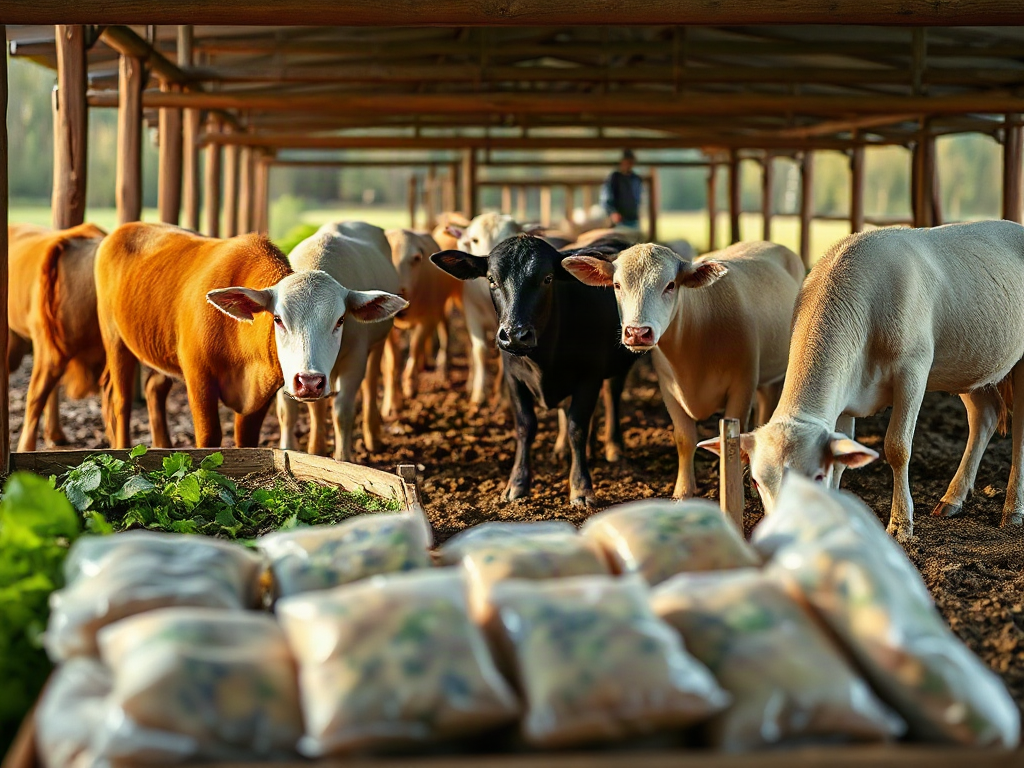
Self-sustaining farm systems reduce outside inputs by cycling nutrients, capturing water, producing part of their own livestock feed, and matching animal numbers to the land’s carrying capacity. Reliable systems connect compost, manure, crop residues, cover crops, rotational grazing, and stored rainfall without assuming the farm can become completely independent. The strongest first move is to identify recurring purchases, then redesign the largest controllable expense as an on-farm cycle. Progress should be measured through soil cover, water reserves, forage availability, nutrient losses, and whether production remains stable during dry periods or supply disruptions.
Design the Farm Around Resource Flows
A farm becomes less dependent on purchases when materials leaving one enterprise become useful inputs for another. Crop residues can protect soil or supply bedding, bedding and manure can become compost, cover crops can feed grazing animals, and captured roof runoff can serve nurseries or livestock after suitable storage and handling. The design task is not to collect disconnected sustainability features. It is to create short, manageable loops that retain fertility, water, carbon, and biological production on the property.
Begin with a resource-flow map covering one full production year. Record what enters the farm—seed, fertilizer, feed, bedding, fuel, irrigation water, replacement animals, and pest-control products—and what leaves as crops, livestock, runoff, waste, or discarded biomass. Add seasonal timing because a resource available in June may not solve a shortage in February. A pile of autumn crop residue, for example, has limited value as winter bedding unless it can be harvested dry and stored under cover.
The most productive loops solve a real expense without creating a larger labor or infrastructure burden. Composting manure near the barn may reduce nutrient purchases and hauling distance. Moving wet manure across the property every day, by contrast, can consume time and compact travel lanes. Likewise, a pond may store runoff, but it is not automatically dependable irrigation. Its usefulness depends on catchment area, evaporation, seepage, water quality, pumping energy, and whether rainfall arrives before peak crop demand.
Farm layout strongly affects whether these loops remain practical. Place high-attention crops, compost bays, wash areas, and frequently used livestock facilities close enough to share labor and materials. Keep clean water separate from manure-laden runoff, and avoid routing animals through vegetable production areas where food-safety concerns arise. Gravity-fed movement of water or manure is attractive only where it can be controlled; an uncontrolled downslope flow is a pollution pathway rather than a closed loop.
A useful design sequence is to choose one costly input, trace why it is needed, identify a farm-produced substitute, and calculate the new demands for land, labor, storage, and timing. Readers developing Self-sustaining farm systems that reduce outside inputs should favor loops that remain useful even when yields fluctuate. The common mistake is trying to close every loop at once. A system with several unfinished projects is usually less resilient than one dependable composting, grazing, or water-storage cycle.
Build Fertility Without Depending on Purchased Nutrients
Soil fertility is the foundation of low-input production, but nutrient cycling does not create nutrients from nothing. Harvested food exports nitrogen, phosphorus, potassium, and micronutrients from the farm. Erosion, leaching, volatilization, and runoff create additional losses. A credible fertility program therefore combines soil protection, biological nitrogen inputs, efficient manure use, targeted testing, and occasional amendments when the nutrient budget shows a genuine deficit.
Keep living roots and protective cover on the soil for as much of the year as local conditions allow. Cover crops capture nutrients that might otherwise move below the root zone, feed soil organisms, suppress some weeds, and protect the surface from raindrop impact. Legumes may contribute biologically fixed nitrogen when inoculation, soil conditions, moisture, and growth are adequate. Grasses produce fibrous roots and durable residue but can temporarily tie up available nitrogen as high-carbon material decomposes. A mixture can balance these functions, although seed cost and termination complexity rise with diversity.
Compost is most useful as a managed nutrient source, not a universal cure for weak soil. Combine nitrogen-rich materials such as fresh manure or green plant matter with drier, carbon-rich bedding or stalks, maintain enough moisture for decomposition, and prevent the pile from becoming saturated. Finished compost should be applied according to crop needs and soil-test results. Repeated heavy applications may accumulate phosphorus or salts even when crops still appear hungry for nitrogen.
Consider a mixed vegetable and poultry operation. Birds can consume culled produce and approved farm-grown feeds, while their manure and bedding enter a composting system. The finished material can support fields that grow market crops and future poultry forage. Yet poultry manure alone does not make the arrangement self-balancing: birds still remove nutrients through eggs or meat, grain production requires acreage, and raw manure introduces food-safety and handling constraints. Compost timing, storage, application records, and separation from harvest activities matter as much as the loop itself.
Signs of progress include stable ground cover, improved infiltration, vigorous roots, less visible erosion, and crop performance that aligns with soil and tissue observations. Warning signs include persistent nutrient deficiencies, sour or anaerobic compost, bare soil after harvest, manure accumulation near barns, or rising soil phosphorus. The weak assumption is that avoiding synthetic fertilizer automatically creates a self-sustaining system. Nutrient form matters less than whether additions, removals, and losses are understood. Use laboratory soil testing and locally appropriate extension guidance before reducing purchased fertility sharply.
Link Water, Crops, and Livestock Without Overloading the Land
Water and feed set hard limits on how much production a farm can support. Rain barrels, ponds, swales, grazing rotations, fodder plots, and perennial forage can reduce purchases, but none removes the need to calculate seasonal demand. Farm capacity should be based on the driest or least productive period that must be carried, not on abundant spring growth or a single favorable year.
Separate water conservation from water storage. Soil protected by residue and roots can absorb more rainfall and lose less moisture to surface evaporation, while contour-aware earthworks may slow runoff where soils, slope, and local rules make them suitable. Tanks and ponds shift water through time, but storage volume must match the intended use. Livestock drinking water is relatively steady and safety-critical; irrigating a field during hot weather can draw down reserves rapidly. Stored water also needs attention to algae, sediment, contamination, freezing, pumps, filters, overflow, and access for maintenance.
Livestock can convert forage and crop by-products into food and manure, yet too many animals turn a nutrient cycle into a feed-import and waste-disposal problem. Rotational grazing works when plants receive enough recovery time and paddocks have suitable water, shade, fencing, and stock density. Moving animals frequently does not compensate for inadequate forage growth. During drought, slow growth, or winter dormancy, maintaining the same herd may require purchased hay that overwhelms the farm’s low-input goals.
A small ruminant operation illustrates the tradeoff. Goats or sheep may browse perennial vegetation, graze cover crops at appropriate stages, and provide manure for nearby fields. If the farm retains every offspring, however, winter forage demand rises faster than pasture recovery. Overstocking then exposes soil, increases parasite pressure around repeatedly used areas, and shifts costs into hay, veterinary care, and fence repair. Selling or separating animals before the forage deficit develops is often more resilient than trying to grow emergency feed after conditions deteriorate.
Use a conservative forage budget that compares expected dry matter with animal demand by month, including storage and feeding losses. Maintain a drought reserve or a predetermined destocking threshold rather than treating purchased feed as an unlimited fallback. Crop choices should follow the same logic. Dry beans, winter squash, forage sorghum, perennial pasture, or regionally adapted grains may store or withstand stress differently, but suitability depends on climate, soil, equipment, and markets.
The practical standard for Self-sustaining farm systems that reduce outside inputs is not maximum production per acre in the best season. It is acceptable production without degrading soil or exhausting stored water when conditions tighten. Bare patches, muddy sacrifice areas, falling pond levels, declining body condition, or repeated emergency feed purchases signal that the crop-livestock-water balance needs correction.
Replace Inputs in the Right Order and Track the Results
Input reduction should follow cost, risk, and replaceability rather than ideology. Some purchases protect animal health, crop quality, food safety, or the long-term nutrient balance and should not be removed simply to claim independence. Seed genetics, mineral supplements, veterinary services, laboratory tests, replacement parts, and carefully chosen soil amendments may remain sensible outside inputs. The goal is to reduce fragile dependence while retaining inputs that prevent larger losses.
Review twelve months of invoices and group expenses by feed, fertility, water, energy, seed, bedding, pest management, repairs, and hired services. Mark each item according to whether the farm can avoid the need, use it more efficiently, produce a substitute, or maintain a strategic reserve. Feed often deserves early attention because waste reduction, better storage, forage improvement, and herd sizing may save more than attempting to grow every ration ingredient. Fertility may be another strong target where manure or crop residues are currently wasted.
Use this compact priority check before committing land or money:
- Measure the baseline: Record annual quantity, cost, delivery risk, and the enterprise consuming the input.
- Test one replacement: Trial a cover crop, compost rate, grazing block, rain tank, or homegrown feed ingredient at manageable scale.
- Count hidden demands: Include labor, storage losses, fencing, machinery, energy, and land removed from cash production.
- Set a failure threshold: Decide what crop response, animal condition, water reserve, or labor burden would stop the trial.
- Expand only after a full cycle: Seasonal performance matters more than a successful week or harvest.
Suppose a farm replaces purchased bedding with baled crop stalks. The idea works only if the stalks remain clean and dry, equipment is available at harvest, storage prevents mold, and removing residue does not leave the source field exposed to erosion. Chipped woody material might last longer in some housing systems but decompose more slowly in compost. Purchased bedding could still be the better option if on-farm collection damages soil or consumes scarce harvest labor.
Track a small set of operational indicators: purchased input per unit of production, hours spent handling substitutes, stored feed at the start and end of winter, water reserve during peak demand, soil-test trends, crop yields, animal condition, and material discarded as waste. Falling purchases accompanied by weaker yields, poorer animal condition, or soil depletion are not success. By contrast, stable production with lower waste and a larger seasonal reserve indicates that the new loop is doing useful work.
A common failure mode is replacing money with uncounted labor. Another is investing in infrastructure before proving that the biological process works at small scale. A detailed approach to Self-sustaining farm systems that reduce outside inputs treats resilience as measurable capacity: the farm can absorb a delayed delivery, dry month, or price increase without transferring the cost to depleted soil, overworked people, or underfed animals.
Frequently Asked Questions
Can a farm become completely self-sufficient?
Complete self-sufficiency is uncommon and may be counterproductive. Most farms still need selected seed, minerals, repairs, testing, health services, or nutrient replacements; resilience comes from reducing critical dependencies without hiding soil, labor, or animal-welfare costs.
Which outside input should be reduced first?
Start with a large recurring cost that has a practical on-farm substitute. Feed waste, imported fertility, purchased bedding, and irrigation losses are common candidates, but invoices and seasonal records should determine the priority.
Do livestock make a farm more self-sustaining?
Livestock can cycle forage, residues, and manure, but only when herd size fits year-round feed and water capacity. Overstocking usually increases purchased feed, soil damage, waste concentration, and health pressure.
How long does it take to reduce purchased inputs?
Evaluate changes across at least one complete production cycle. Soil-building, perennial forage, compost systems, and water storage may require multiple seasons before their costs, labor demands, and reliability are clear.
How can a farmer tell whether a closed loop is working?
Look for stable production, lower purchases per unit produced, adequate feed and water reserves, improving ground cover, manageable labor, and no worsening soil-test or animal-condition trends.
Further Reading
Authoritative Sources
- USDA Natural Resources Conservation Service: Soil Health
nrcs.usda.govExplains soil-cover, living-root, diversity, and disturbance principles relevant to retaining fertility and water on farms
- SARE: Managing Cover Crops Profitably
sare.orgProvides crop-specific information for choosing and managing cover crops within low-input rotations
- U.S. EPA: Agriculture Nutrient Management and Fertilizer
epa.govOffers context on managing agricultural nutrients while limiting losses to air and water
- ATTRA Sustainable Agriculture: Soils and Compost
attra.ncat.orgCollects practical resources on composting, soil management, and biologically based fertility systems
Conclusion
Durable farm autonomy comes from connecting enterprises without asking the land to supply more than it can replace. Map annual inputs and losses, then strengthen one high-value loop—such as composted manure returning to tested fields, rainfall stored for a defined use, or forage production matched to conservative livestock numbers. Measure labor and infrastructure alongside purchase savings so a cheaper input does not become an expensive burden elsewhere.
Protect soil cover, maintain clean and reliable water reserves, and preserve access to outside services or materials that prevent serious production, safety, or welfare failures. The next practical step is a twelve-month input audit followed by one limited trial with a clear success measure and stopping point. Expand the change only after it performs through the season when the farm is under its greatest pressure.