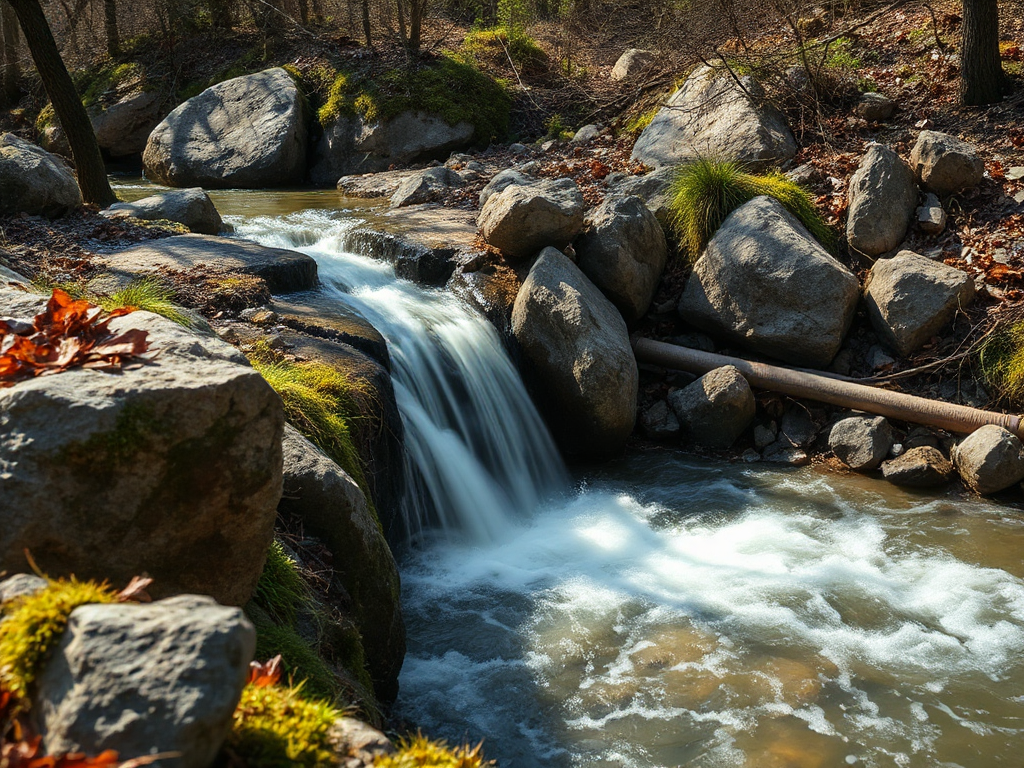
Microhydro feasibility for year-round off-grid electricity depends on dependable water flow, usable vertical drop, and equipment that can operate through the site’s lowest-flow season. Measure head and flow at several times of year, then estimate power from both values rather than judging a stream by its appearance. A system may produce excellent output in spring yet fail to cover winter loads when drought, freezing, intake blockage, or reduced stream flow cuts generation. Confirm civil-work access, water rights, environmental constraints, transmission distance, and battery or diversion-load needs before buying a turbine. A conservative low-flow design usually provides more reliable autonomy than sizing around a short period of abundant water.
The Measurements That Determine Site Feasibility
A stream is a promising microhydro site only when it combines sufficient flow with usable head, the vertical distance between the intake water level and the turbine. Both measurements matter because hydraulic power rises with flow and head; a fast stream with little elevation change may produce less electricity than a modest stream dropping through a longer penstock. The question is not whether water moves, but whether enough water reaches the turbine at useful pressure during the least productive part of the year.
Measure head before selecting equipment. A surveyor’s level, laser level, pressure gauge, or carefully repeated elevation measurements can establish the route more reliably than visual estimates. Gross head is reduced by bends, valves, pipe friction, screens, and the length of the penstock, leaving net head at the turbine. A steep site may look ideal but require a long, expensive pipeline, while a lower-head site near a building may have simpler construction and lower transmission losses.
Flow measurement needs equal care. A bucket test can help with a small, accessible channel, but larger streams often require a timed cross-section measurement, weir, flume, or professional hydrological assessment. Record conditions after dry weather, during ordinary flow, and during wet periods. Spring runoff is a poor basis for year-round planning because snowmelt or seasonal rain can temporarily inflate production.
Use a conservative design flow rather than the most impressive reading. If the stream becomes shallow in late summer, freezes at the intake, or diverts underground during drought, that period controls feasibility. The surrounding Microhydro feasibility for year-round off-grid electricity decision should therefore begin with a seasonal flow record, not a turbine catalogue.
A common mistake is measuring the stream beside the proposed powerhouse and assuming that value represents the intake. Water may leak from the channel, split around rocks, or be unavailable at the diversion point. Measure where water will actually enter the system, and document the route, elevation, access, land ownership, and likely flood path at the same time.
Estimating Useful Output Through the Seasons
Expected electrical output is governed by head, flow, and total system efficiency. A simplified estimate is hydraulic power in watts equal to water density, gravitational acceleration, flow rate, and net head, multiplied by the combined efficiency of the turbine, generator, controller, and wiring. Real systems do not convert all available water energy into electricity, so a generous theoretical calculation should never be treated as a guaranteed household supply.
Seasonal analysis changes the answer. A site that provides 2 kilowatts during a wet month may fall below a few hundred watts during a dry period. That lower figure may still be valuable if it runs continuously, because steady generation can supply refrigeration, networking, ventilation, and battery charging without the large battery bank needed by intermittent sources. It may be inadequate, though, for electric resistance heating, water heating, workshop machinery, or other heavy loads.
Compare generation with the load profile, not merely the daily energy total. A turbine producing modest power around the clock can outperform a larger but intermittent source for overnight baseloads. Conversely, a home with short, high-power demand may need an inverter and battery system capable of handling peaks even when the turbine is operating. Excess generation also needs a controlled destination, commonly a diversion load such as water heating, because simply disconnecting a running turbine can create damaging overspeed or voltage conditions depending on the equipment.
Build a month-by-month model using low, typical, and high flow assumptions. Include penstock losses, generator efficiency, controller behavior, battery charging losses, maintenance downtime, and a reserve for intake problems. Then compare the result with essential loads and total loads separately. If winter flow covers only essential circuits, a hybrid plan using solar, a generator, or load shedding may be more rational than expanding the turbine.
Weak assumptions often come from treating nameplate output as continuous output. A turbine rated for a particular head and flow may produce much less when the intake is throttled, the screen is clogged, or water levels fall. Ask the installer for performance information at the actual net head and design flow, and test whether the proposed system remains useful below that point.
Civil Works, Turbine Choices, and Electrical Design
Microhydro projects are frequently decided by civil works rather than by the generator itself. The intake must divert water while resisting flood debris, sediment, ice, and channel movement. A settling area or sediment-management approach may be needed before water enters the penstock. The pipeline must tolerate pressure, burial or exposure conditions, drainage, and accessible maintenance points. Every added bend, narrowing, and rough interior surface consumes head.
Turbine selection follows the measured head and flow range. High-head, lower-flow sites may suit impulse designs such as Pelton or Turgo machines, while lower-head sites may call for crossflow, propeller, or other reaction-oriented equipment. The labels are less useful than the operating envelope: a machine optimized for a narrow flow range may be efficient at its design point but disappointing when drought reduces water availability. A unit that accepts a broader range may deliver less peak output but more useful annual energy.
Consider electrical distance early. Locating a turbine near the stream can reduce penstock length but increase the cable run to the house; locating it closer to the building may shorten transmission while requiring more pipe. Higher-voltage transmission can reduce line losses, but it introduces equipment, insulation, grounding, and installation requirements that need competent design. Batteries, inverters, disconnects, surge protection, and controls must be matched to the generator rather than added as unrelated components.
For example, a remote cabin might have adequate head and flow but a long, rocky route between intake and powerhouse. Blasting, road access, and future repair difficulty could outweigh the energy benefit. A less productive alignment with a shorter buried penstock may be the better project because it lowers failure exposure and makes inspection possible. This is where Microhydro feasibility for year-round off-grid electricity becomes a site-engineering judgment rather than a simple power calculation.
Do not overlook water management. A diversion system can affect downstream flow, fish passage, neighboring users, and flood behavior. Requirements vary by location, so confirm applicable water, land-use, environmental, electrical, and construction rules before committing funds. A technically sound turbine cannot compensate for an intake that cannot legally or safely be built.
Reliability Risks, Costs, and a Practical Go-or-No-Go Test
Year-round reliability depends on maintenance access as much as on hydrology. Screens collect leaves, needles, and sediment; storms move rocks; freezing weather can damage exposed components; and rodents or moisture can affect electrical equipment. Plan for safe shutoff, drain-down, inspection, and replacement of wear parts. If reaching the intake requires a dangerous winter journey, the system may be unavailable precisely when dependable generation matters most.
Cost comparisons should include the complete water-to-load system: surveys, intake, settling, penstock, anchors, powerhouse, turbine, generator, controls, transmission, batteries, inverter equipment, earthwork, permits, labor, and contingency. A turbine quote alone can make a marginal site appear attractive. Civil construction may dominate the budget, especially where the route crosses rock, unstable slopes, wetlands, roads, or property boundaries.
Use a staged feasibility process before ordering hardware:
- Confirm the site: map the intake, turbine location, net head, pipe route, access, and flood exposure.
- Confirm the water: collect seasonal flow data and identify the conservative design flow.
- Confirm the load: separate essential energy, peak power, and discretionary loads by season.
- Confirm the project: obtain preliminary equipment performance, civil-work estimates, and regulatory feedback.
- Stress-test the plan: model drought, freezing, blocked screens, maintenance outages, and battery failure.
A project is stronger when the low-flow case still covers critical loads or has a defined backup. It is weaker when the financial case depends on peak spring output, unverified head, or continuous unattended operation. Solar may be a better complement where summer water is unreliable but sunlight is abundant; a generator may be more practical where civil works are expensive and fuel logistics are manageable. Microhydro is most compelling when water runs steadily, head is close to the usable load center, and the owner can maintain the intake.
Signs the approach is working include stable voltage, predictable flow-based output, manageable screen cleaning, and batteries reaching their intended charge pattern without excessive diversion. Warning signs include repeated low-water shutdowns, sediment damage, unexplained output loss, overheating, or a load model that assumes the turbine will cover short high-power surges. Correct those assumptions before increasing capacity. The Microhydro feasibility for year-round off-grid electricity assessment should end with a documented decision: build, redesign, add a hybrid source, or abandon the site.
Frequently Asked Questions
What makes a stream suitable for microhydro?
A suitable site has dependable seasonal flow, measurable net head, a buildable intake and penstock route, manageable environmental constraints, and access for maintenance. Flow during the driest important season matters more than a visually impressive spring current.
How do head and flow affect turbine output?
More net head or more flow generally increases available hydraulic power, but pipe friction and equipment efficiency reduce the electricity delivered. Both values must be measured at the actual intake and turbine locations.
Can microhydro work during winter?
It may, provided water remains available and the intake, penstock, controls, and powerhouse are protected from ice and flood conditions. Winter performance should be based on measured cold-season flow, not summer observations.
Does microhydro eliminate the need for batteries?
Not necessarily. A steady turbine can reduce battery cycling, but batteries may still be needed for load peaks, regulation, outages, and periods when the turbine is stopped for cleaning or repair.
What is the most common feasibility mistake?
Designing around peak flow is a frequent error. A conservative low-flow model, complete civil-work estimate, and realistic maintenance plan provide a more useful picture of year-round performance.
Further Reading
Authoritative Sources
- Ready.gov
ready.govOfficial household preparedness guidance, emergency plans, and supply checklist resources.
- FEMA
fema.govFederal emergency management information, disaster planning resources, and recovery guidance.
- American Red Cross Emergency Preparedness
redcross.orgPractical emergency preparation, safety, and response guidance for households.
- CDC Emergency Preparedness and Response
cdc.govPublic health guidance for disasters, emergency response, and recovery conditions.
Conclusion
A viable microhydro site is defined by dependable low-season water, verified net head, a practical construction route, and an electrical system matched to actual loads. Measure the stream across seasons, subtract pipe and equipment losses, and test the plan against drought, ice, debris, maintenance outages, and peak demand. Treat nameplate power and spring runoff as optimistic reference points rather than guarantees. Before spending on a turbine, obtain a site-specific civil estimate, confirm local requirements, and decide how batteries, diversion loads, solar, or a generator will cover gaps. The best project may not be the one with the highest theoretical output; it is the one that remains serviceable, affordable, and useful when water conditions are least favorable.