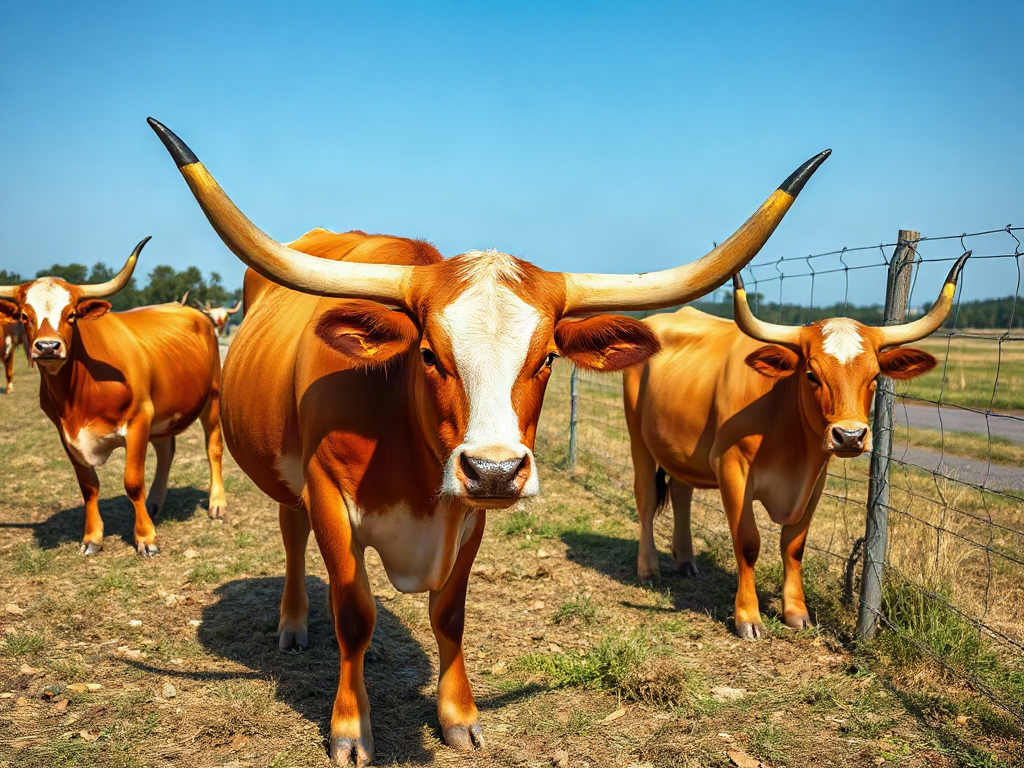
Raising longhorn cattle successfully as a beginner requires land matched to forage production, fencing that discourages reaching and rubbing, and handling facilities designed around wide horns. Stocking capacity should be based on usable grazing and seasonal feed supply rather than a fixed acres-per-cow rule. Alleys, gates, and chutes need enough lateral clearance to prevent horns from catching, yet they must still limit turning and unsafe movement. Begin with calm cattle, teach them to follow a consistent feed or mineral routine, and arrange veterinary, hauling, water, shade, and winter-feed plans before animals arrive.
Match Herd Size to Usable Grazing Land
Longhorn acreage should be calculated from forage production, not from the visual size of a property. Two parcels with the same acreage can support very different numbers of cattle because soil, rainfall, slope, plant species, previous grazing pressure, and seasonal growth all affect available feed. Wooded corners, ponds, lanes, buildings, and inaccessible slopes should not be counted as productive pasture simply because they appear on the deed.
A beginner should ask a local extension office or grazing specialist how carrying capacity is commonly estimated in the area. Local guidance may be expressed in animal-unit months, forage yield, or typical stocking rates. Those figures are starting points rather than promises. A mature cow with a calf consumes more than a young animal, while drought, dormant pasture, and heavy trampling reduce what the land can provide. Longhorns are often described as hardy and efficient foragers, but hardiness does not turn poor pasture into adequate nutrition.
Consider a property with several open paddocks and a large brushy section. The cattle may browse some woody growth, yet that section cannot automatically replace grass acreage. If the open paddocks are grazed down before plants recover, adding access to brush may merely postpone a forage shortage. Monitoring residual grass height, manure consistency, body condition, and how quickly cattle return to recently grazed areas gives a clearer picture of whether stocking pressure is too high.
Rotational grazing can improve control, but it does not manufacture forage. Dividing land into paddocks allows grazed plants a recovery period and makes it easier to reserve grass for later. Continuous access is simpler and requires less interior fencing, but cattle repeatedly select preferred plants and may leave undesirable growth untouched. Beginners often benefit from a modest rotation with a few functional paddocks rather than an elaborate system that is difficult to maintain.
Plan stored forage before pasture becomes scarce. Identify a reliable hay source, a weather-protected storage area, and a feeding location that delivery vehicles can reach without crossing saturated ground. Soil testing and forage testing can guide amendments and supplementation without relying on appearance alone. The land plan described in Raising longhorn cattle for beginners: handling and land should leave enough reserve capacity for dry weather, pasture recovery, and the higher demands of lactation.
Build Fences, Water, and Shade for Longhorn Behavior
Perimeter fencing must account for cattle that can reach farther through or over a barrier than compact, hornless animals. Longhorns may extend their heads toward grass outside the fence, rub against posts, or lift wire with their horns. A fence that technically contains ordinary cattle may deteriorate quickly if animals repeatedly pressure it for forage, shade, or social contact.
Fence type should reflect terrain, road exposure, predator pressure, maintenance capacity, and local practice. Well-built woven wire offers a visible physical barrier but can create horn-entanglement concerns if cattle push their heads through it. High-tensile electric fencing can work effectively when animals are trained to respect it, vegetation is controlled, grounding is adequate, and voltage is checked routinely. Barbed wire is common in some cattle regions, but poor tension, sagging strands, or crowded corners increase injury risk. Local rules and neighboring land uses may also affect the appropriate choice.
Interior electric divisions are usually easier to alter than permanent fencing. Training should take place in a secure enclosure where a failed electric line will not lead directly to a road or neighboring property. The common mistake is installing a charger and assuming the job is finished. Weeds touching the wire, weak grounding, damaged insulators, dry soil, or a depleted power source can reduce the deterrent. A fence tester provides more useful information than touching the wire or judging it by sound.
Water placement influences how cattle use the land. A dependable system needs adequate flow, sufficient trough capacity, freeze protection where necessary, and firm footing around the drinking area. Mud near a trough wastes pasture, damages hooves, and makes inspection difficult. Check whether the system can meet demand during hot weather and whether a power or pump failure would leave the herd without water. A backup tank or emergency connection is more valuable than an improvised solution after a breakdown.
Shade and wind protection should fit the climate. Natural tree cover can be useful, but cattle concentrated under a few trees may compact soil and damage roots. Portable shade can distribute pressure, while permanent structures offer predictability but cost more and may become muddy gathering points. Walk the property as if moving a wide-horned cow: inspect narrow gates, exposed hardware, loose wire, dead-end corners, and gaps beside troughs. Signs of failure include bent posts, hair on wire, worn escape paths, repeated pacing, and cattle reaching aggressively beyond the boundary.
Design Handling Facilities Around Horn Width
Handling facilities for longhorns need lateral clearance where horns pass through while still controlling the animal’s body. Conventional cattle equipment may have overhead braces, narrow openings, or abrupt turns that catch horn tips. Simply making every space wider is not the answer; excessive room allows cattle to turn around, swing their heads, or place handlers within the horn arc.
A practical layout includes a gathering area, a crowding area, a single-file alley, controlled gates, and a restraint point appropriate for veterinary work. Smooth-sided alleys reduce visual distractions and discourage cattle from challenging openings. Curved approaches may support forward movement when the animal can follow the one ahead, but any design must preserve safe access and avoid blind traps. Gate latches should be operable from outside the animal’s path, and escape routes should be available to people without creating openings cattle can exploit.
Measure the actual animals rather than selecting equipment from a photograph. Horn shape matters as much as tip-to-tip span: horns may sweep outward, rise, twist, or angle forward. A young cow that passes easily today may outgrow a fixed opening. Before buying a squeeze chute or headgate, ask the manufacturer whether the model is intended for horned cattle and how side exits, top bars, and head restraint function with the anticipated horn shape. Veterinary procedures may require specialized restraint, so discuss the planned setup with the veterinarian who will use it.
For example, forcing a wide-horned cow through a narrow self-catching headgate can cause panic when the horns contact steel. A safer arrangement may use a longhorn-compatible restraint system, removable panels, or carefully controlled access that lets the head and horns clear without giving the animal room to pivot. The appropriate option depends on horn dimensions, animal temperament, procedure, and operator experience; improvised roping or tying should not substitute for competent restraint.
Test the flow before urgent work is needed. Move one calm animal through without performing a procedure, observe where it stops, and correct shadows, flapping material, protruding bolts, slippery flooring, or noisy gates. Never stand directly in front of an animal or within the sweep of its horns. The handling component of Raising longhorn cattle for beginners: handling and land succeeds when cattle move without repeated pressure and handlers can operate gates from protected positions.
Establish Safe Daily Handling and Herd Routines
Calm handling begins with predictable movement, adequate space, and attention to the animal’s response. Longhorns can become accustomed to routine contact, but familiarity should not be confused with harmlessness. A gentle cow can react abruptly when separated from the herd, protecting a calf, experiencing pain, or entering unfamiliar equipment. Horns enlarge the area affected by a quick head movement even when the animal is not attempting to strike.
Use the cattle’s flight zone and point of balance rather than pushing continuously from behind. Pressure applied from the side can initiate movement; releasing pressure when the animal responds rewards the correct direction. Crowding, shouting, dogs used without control, and blocking the destination tend to increase speed and turning. Beginners should work from outside sturdy barriers until they can read ear position, head carriage, bunching, repeated attempts to turn, and fixation on an exit.
A consistent call paired with a small, controlled feed reward can make pasture moves easier. The reward should lead cattle into a prepared destination, not lure them through a person’s space. Hand-feeding encourages animals to crowd, search clothing, or swing their heads near the handler. Place feed in a bunk, step away, and avoid creating competition at a narrow gate. Several feeding spaces are safer than one crowded point.
Temperament deserves as much attention as color, horn potential, or pedigree. A beginner herd is easier to manage when animals are accustomed to people, trailers, gates, and basic restraint. Ask the seller how each animal behaves when separated, loaded, treated, or accompanied by a calf. Observe cattle rather than relying solely on descriptions. An animal that repeatedly charges gates, refuses containment, or threatens handlers may be unsuitable for an inexperienced owner even if it has desirable genetics.
Do not work cattle alone when the task involves confinement, loading, calving trouble, illness, or veterinary treatment. Establish who will help, how emergency services can reach the pasture, and where a trailer can turn around. Progress is visible when cattle enter the handling area at a walk, maintain spacing, and recover quickly after release. Repeated fence impacts, frantic circling, crowding, slipping, or handlers improvising from inside the pen signal that the system or technique needs correction before another attempt.
Prepare a Before-Arrival Property Checklist
A property should be tested as an operating cattle system before the first longhorns are unloaded. Buying animals first creates pressure to accept unfinished fences, unsuitable equipment, uncertain hay supplies, or no quarantine space. Delaying arrival is cheaper and safer than repairing weaknesses while cattle are already testing them.
Use a compact readiness check:
- Containment: Walk every fence line, energize and test electric sections, secure gates, and inspect road-facing boundaries.
- Feed and water: Confirm pasture availability, hay storage, mineral placement, trough flow, and an emergency water source.
- Handling: Measure gates and restraint equipment against expected horn width and remove projections or dead ends.
- Access: Provide all-weather routes for hay delivery, veterinary vehicles, trailers, and carcass removal if required.
- Animal support: Arrange a veterinarian, identify records needed for purchase or movement, and create a plan for isolation and observation.
Quarantine needs vary with herd history, disease risk, veterinary guidance, and local requirements. At minimum, new animals should have a separate area where appetite, manure, movement, coughing, injuries, and body condition can be observed without immediate nose-to-nose contact with resident cattle. Shared troughs and equipment can undermine separation. Ask a veterinarian what testing, vaccination, parasite control, and identification practices fit the source herd and destination region rather than copying a generic schedule.
Budget for recurring costs that acreage alone does not reveal. Hay, minerals, fence repair, equipment maintenance, veterinary care, hauling, pasture improvement, and winter water systems can exceed the initial cost of a small herd. Breeding adds calving risk, bull-management requirements, and the need to manage young stock. Beginners who primarily want grazing animals may find steers or nonbreeding cows more manageable than beginning immediately with a breeding pair or mature bull.
Complete a low-pressure trial before delivery: fill the trough, operate every gate, drive the trailer route, run the chute empty, and inspect the pasture after dark. Confirm local fencing, livestock movement, identification, and land-use obligations with the relevant authorities. A written plan based on Raising longhorn cattle for beginners: handling and land should identify the responsible person, backup contact, feed reserve, and response to an escaped or injured animal.
Frequently Asked Questions
How many acres does one longhorn need?
No universal acreage figure is reliable. Estimate capacity from local forage production, usable pasture, animal size, grazing season, and the amount of hay available when grass is dormant or drought-stressed.
Can longhorn cattle be kept behind electric fencing?
Electric fencing can be effective when cattle are trained to it, the energizer and grounding system are adequate, vegetation is controlled, and a secure perimeter protects against equipment failure.
Do longhorns need a special cattle chute?
They need restraint equipment compatible with their horn span and shape. Confirm clearances, braces, exits, and head-control features with the manufacturer and the veterinarian expected to use the facility.
Are longhorn cattle safe for first-time owners?
Calm, well-handled animals may suit prepared beginners, but horns, maternal behavior, confinement, and unfamiliar procedures create serious risks. Temperament, protected working positions, and experienced help should drive the purchase decision.
Should a beginner keep a longhorn bull?
A mature bull adds substantial fencing, handling, breeding, and safety demands. Many beginners are better served by steers, nonbreeding cows, or outside breeding arrangements until their facilities and cattle skills are established.
Further Reading
Authoritative Sources
- USDA Natural Resources Conservation Service State Offices
nrcs.usda.govState NRCS offices provide region-specific pathways to grazing, soil, water, and conservation planning assistance
- USDA APHIS Livestock and Poultry Disease
aphis.usda.govThis federal resource explains livestock disease programs and directs owners toward current animal-health information
- Texas Longhorn Research at Utah State University
longhorn.usu.eduUsu.eduUtah State University maintains breed-focused educational material relevant to Texas Longhorn history, genetics, and management
- University of Nebraska–Lincoln Beef
beef.unl.eduThis extension resource covers practical cattle production topics, including grazing, facilities, nutrition, and herd management
Conclusion
A sound longhorn setup is built by testing the property against the animals that will actually use it. Calculate herd size from productive forage and seasonal reserves, then secure water, shade, perimeter fencing, and vehicle access before delivery. Measure horn width and shape against every gate, alley, and restraint point rather than assuming standard cattle equipment will work.
Choose calm cattle with known handling histories, avoid beginning with a mature bull, and arrange veterinary and experienced help before a difficult situation develops. The next practical step is a full property walk with fence-testing equipment, written measurements, a pasture map, and a list of unresolved failures. Do not schedule animal arrival until containment, feed, water, and safe restraint all work under realistic conditions.