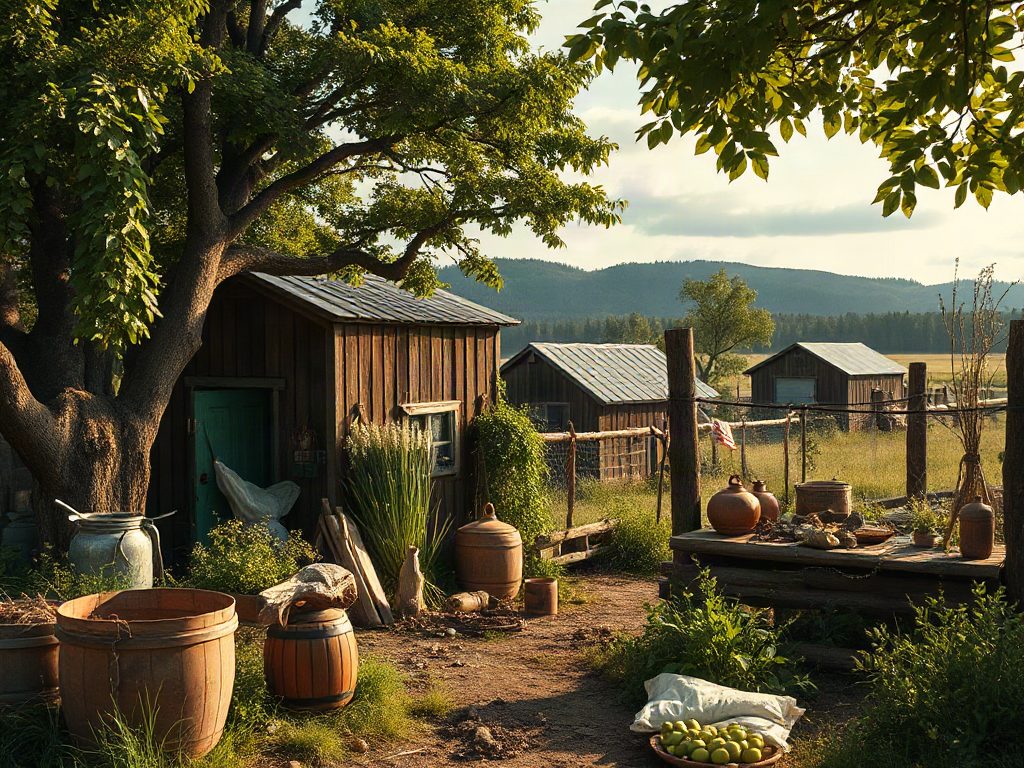
Types of homesteading differ mainly in which systems receive the most space, labor, and money: urban models emphasize compact food production and waste cycling, rural models prioritize land-based crops and livestock, and off-grid models center on energy, water, and sanitation. Permaculture-oriented sites organize those systems around ecological relationships, while income-producing homesteads treat enterprises and cash flow as core infrastructure. No type is automatically more self-reliant than another. The strongest choice matches household goals, property limits, climate, available time, and maintenance capacity rather than trying to install every possible system at once.
How Do Homestead Types Actually Differ?
A homestead type is best identified by its dominant operating system, not by acreage or visual style. Two properties may both have gardens, chickens, rain barrels, and workshops, yet function very differently. One household may organize its efforts around producing most of its vegetables, while the other uses food production mainly to support a home-based business. The distinction lies in where labor, capital, storage, and maintenance are concentrated.
Five systems commonly reveal a homestead’s actual emphasis: food, water, energy, waste, and household income. A sixth consideration—housing and land stewardship—connects them. Urban and suburban sites usually place food and waste cycling at the center because space is limited but household scraps, roofs, patios, and nearby markets are accessible. Rural sites can devote more land to grazing, staple crops, woodlots, ponds, or orchards, although distance from services raises transportation and repair demands.
Labels overlap because households rarely operate a pure model. An off-grid property can also be a commercial flower farm, and a suburban lot can use permaculture design while remaining connected to municipal utilities. Treating labels as fixed identities creates a common failure mode: buying equipment associated with an appealing lifestyle before deciding what the property must reliably accomplish.
| Homestead Type | Primary System Emphasis | Typical Constraint |
|---|---|---|
| Urban or suburban | Intensive growing, preservation, composting | Space, ordinances, neighbors |
| Rural production | Crops, livestock, storage, land management | Labor, distance, infrastructure |
| Off-grid | Energy, water, sanitation, backup capacity | Upfront cost and technical upkeep |
| Permaculture-oriented | Ecological relationships and low-input design | Long establishment periods |
| Income-producing | Marketable output, workflow, cash flow | Demand, regulation, profitability |
A useful classification should improve decisions. If a household’s main goal is a dependable vegetable supply, bed layout, irrigation, soil fertility, harvest timing, and preservation capacity matter more than whether the property looks traditionally rural. If reliable operation during utility outages is the priority, stored water, load calculations, fuel plans, and repair access deserve attention before adding more crops or animals. The name matters less than the system that cannot be allowed to fail.
Land- and Food-Production Homesteads
Urban, suburban, rural, and livestock-centered homesteads all produce food, but they use different combinations of space, labor, and infrastructure. Compact sites emphasize output per usable area. Raised beds, containers, trellises, dwarf fruit trees, succession planting, composting, and indoor seed starting can fit around a house without attempting to reproduce a farm at miniature scale. Food preservation may become the crucial bottleneck because a productive garden creates short harvest surges that must be eaten, stored, shared, or processed.
A suburban household with six sunny beds might grow salad crops, herbs, beans, tomatoes, and storage onions while purchasing grain, meat, and dairy. That is not a lesser form of homesteading; it is a bounded food system matched to the site. The common mistake is adding hens, fruit trees, beehives, and a larger garden simultaneously. Each introduces a different calendar of watering, feeding, pruning, harvest, health checks, and cleanup. Space may appear sufficient even when weekly labor is not.
Rural production models use additional acreage for field crops, orchards, pasture, larger livestock, forestry, or hay. Their central systems extend beyond growing food to include fencing, soil access, feed storage, handling areas, equipment movement, predator control, and winter provisions. A few acres of grass do not automatically support grazing animals year-round. Forage growth changes with soil, rainfall, season, and stocking pressure, so purchased feed or rotational access may still be necessary.
Crop-centered and livestock-centered properties also cycle fertility differently. A market garden may rely on cover crops, compost, mulch, amendments, and planned rotations. A livestock operation converts forage and feed into manure, but manure is only useful when collection, storage, composting, and application are manageable. Poor placement can turn a potential soil input into runoff, odor, flies, or excess nutrients near barns.
The practical priority is to design the whole production chain before increasing output. Check where inputs arrive, where tools stay dry, how water reaches crops or animals, where harvests are washed, and how surplus is stored. Signs of a working system include manageable chores, stable soil cover, realistic harvest use, and infrastructure that reduces repeated carrying. Spoiled produce, chronically muddy animal areas, emergency feed purchases, and unfinished preservation projects indicate that production has outgrown its support systems.
Which Types Emphasize Resource Independence?
Off-grid, low-energy, and resilience-focused homesteads give unusual weight to utilities that conventional homes receive through centralized networks. Their key systems include electricity generation and storage, potable and non-potable water, wastewater, heating, cooling, cooking fuel, communications, and emergency backups. Food production may be present, but dependable utility operation usually takes precedence because a failed pump or depleted battery bank can affect sanitation, refrigeration, livestock water, and household safety at the same time.
Off-grid does not mean free of outside inputs. Solar equipment, batteries, pumps, filters, generators, fuel, replacement electronics, and specialized repairs may all depend on external supply chains. Energy planning therefore begins with demand reduction and load prioritization rather than simply installing more generation. Refrigeration, water pumping, workshop tools, electric cooking, and heating loads behave differently; seasonal sunlight and weather can also make annual averages misleading.
Water-independent designs similarly require more than a collection tank. A roof-catchment system needs suitable roofing and conveyance, debris control, storage, overflow routing, freeze protection where relevant, and treatment appropriate to the intended use. Well systems need power, maintenance access, and an understanding of recovery limits. Water used on gardens or livestock may not require the same handling as drinking water, but separating uses must be deliberate and safe. Local rules can govern wells, rainwater, wastewater, and sanitation, so property-specific requirements should be checked before construction.
Permaculture-oriented homesteads pursue a different form of independence: reducing recurring inputs by arranging elements to support one another. Trees may provide shade, wind moderation, leaf litter, habitat, and perennial crops. Swales or other earthworks may be considered for managing water on suitable terrain, while mixed plantings can spread harvests and avoid dependence on one crop. These designs are often slower to establish than annual gardens, and site observation should precede permanent changes. Water movement, sun exposure, frost pockets, access routes, and existing vegetation are difficult to correct after major earthworks or tree planting.
The weak assumption across resource-independent models is that redundancy means owning duplicate equipment. Useful redundancy relies on different failure paths: stored water alongside a powered pump, passive cooling alongside mechanical refrigeration, or a modest generator reserved for essential loads rather than whole-house consumption. Test backup systems under realistic conditions. A system is working when household demand fits available capacity and routine maintenance is scheduled; frequent emergency generator use, tank shortages, battery depletion, or inaccessible components point to a design mismatch.
How Should You Choose a Homestead Type?
The right model is the one whose primary systems fit the household’s nonnegotiable goals and recurring constraints. Begin with outcomes that can be measured operationally: supplying seasonal vegetables, keeping dairy animals, lowering grid dependence, earning income from cut flowers, or maintaining water access during outages. A vague goal such as “becoming self-sufficient” offers no basis for deciding between a greenhouse, a larger cistern, fencing, or a preservation kitchen.
Next, inventory limits before projects. Record usable sunlight, slope, drainage, water availability, storage, vehicle access, zoning or animal restrictions, household skills, physical capacity, and dependable weekly labor. Climate shapes the calendar, but household absence can be equally decisive. Someone who travels regularly may manage perennial crops more easily than dairy animals that require daily attention. A renter may focus on portable containers, countertop preservation, repair skills, and community garden access instead of permanent infrastructure.
Use a short priority sequence to keep the systems coherent:
- Name the primary output. Choose one result the property should deliver reliably.
- Map its dependencies. Identify water, energy, fertility, feed, storage, tools, and processing needs.
- Find the likely bottleneck. Test labor, seasonal capacity, and maintenance before expanding production.
- Add a compatible secondary system. Favor an addition that uses an existing byproduct or resource without creating a fragile chore load.
- Review actual performance. Track purchases, failures, surplus, time demands, and neglected maintenance through a full season.
Consider a household deciding between chickens and a larger garden. Chickens can provide eggs and manure, but they also require secure housing, feed, water, cleaning, and care during travel. Additional garden beds demand irrigation, weeding, harvest handling, and soil inputs but can be left dormant outside the growing season. The better choice follows the household’s food habits and schedule, not a checklist of what a homestead is supposed to contain.
Income-producing homesteads require another filter: a production system is not a business until demand, pricing, workflow, legal requirements, recordkeeping, and delivery are workable. A profitable-looking crop may consume too much washing, packaging, refrigeration, or market time. Separate household resilience goals from enterprise accounting so personal consumption is not mistaken for sales revenue and unpaid labor is not ignored.
Expand when the current system survives peak season without chronic shortcuts. Consistent harvest use, timely repairs, adequate reserves, clean work areas, and predictable chores are better expansion signals than unused land. Repeated losses, deferred fencing, overloaded storage, or dependence on emergency purchases mean the next investment should stabilize operations rather than add another enterprise.
Conclusion
Choosing among homesteading types is an exercise in allocating limited land, labor, money, and attention. Compact properties usually benefit from intensive food production and waste cycling; acreage broadens crop and livestock options but adds infrastructure and maintenance; off-grid sites place utility reliability first; permaculture designs favor long-term ecological relationships; and commercial models must make workflow and demand part of the system.
Write down one primary output, map everything it depends on, and test the likely bottleneck before adding another project. Review performance across a demanding season rather than judging by initial enthusiasm. When chores remain controlled, reserves are adequate, harvests have a destination, and repairs happen on schedule, expansion may be sensible. When those signals are absent, strengthening the existing system will create more genuine autonomy than collecting additional homestead features.
Frequently Asked Questions
Can one property combine several types of homesteading?
Yes. Most working homesteads are hybrids, such as a rural food-producing property with off-grid backup power and a small farm enterprise. Assigning one primary emphasis prevents competing systems from consuming more labor and money than the household can support.
Which homesteading type works best with limited space?
Urban or suburban homesteading usually fits limited space because it emphasizes intensive beds, containers, vertical growing, composting, and preservation. Select crops by sunlight, household use, and value per growing area rather than trying to produce every staple.
Does off-grid homesteading require producing all your own food?
No. Off-grid generally describes utility systems rather than complete food independence. A property may generate electricity and manage its own water while purchasing most food, fuel, tools, and replacement components.
Is permaculture a separate homesteading type?
Permaculture is often better treated as a design approach that can shape urban, rural, or off-grid properties. It emphasizes relationships among water, soil, plants, animals, buildings, and human work rather than prescribing one property size or production goal.
What system should a new homesteader build first?
Start with the system supporting the primary goal, then secure its main dependency. A vegetable-focused site may need reliable irrigation and soil preparation first, while an outage-resilient property may need water storage and a carefully sized backup-power plan.
Further Reading
Authoritative Sources
- USDA Natural Resources Conservation Service: Conservation by State
nrcs.usda.govState-level conservation resources can help landowners investigate soil, water, grazing, and land-management support relevant to production homesteads
- Land-Grant University Partner Directory
nifa.usda.govThis directory helps readers locate regional Extension information suited to local crops, livestock, soils, climate, and household food systems
- Planning for Home Renewable Energy Systems
energy.govThe U.S. Department of Energy explains the planning factors behind household renewable-energy systems, including load analysis and site conditions
- Soak Up the Rain: Rain Barrels
epa.govThis EPA resource covers basic rain-barrel use and limitations for readers considering small-scale water collection